
Fibres · Animal
Merino Wool
Wool par excellence: springy, warm, resilient and soft enough not to prickle. It is the easiest choice for starting to knit, because it forgives mistakes and always springs back into shape.
Translated from Italian. A native knitter has not reviewed this translation yet.
History
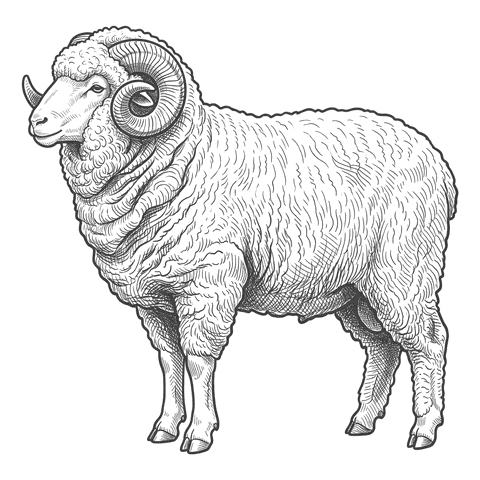
Bred in Spain, which banned its export until the eighteenth century to protect its monopoly, the Merino sheep reached Australia at the end of the eighteenth century and rebuilt the world wool industry there. Its modern prestige runs through the Woolmark brand, born in 1964, and through the textile districts of Biella and Prato, still reference points today for high-end worsted yarns.
How the yarn is made
It comes from the annual shearing of the fleece. The fibre is then combed, for smooth, compact, fine worsted yarns, or carded, for softer, bulkier and warmer woollen yarns. The same wool, with the two processes, gives two very different hands.
Why it is prized
It is knitwear's best compromise: warm, springy, resilient and fine enough not to prickle, yet available in industrial volumes. The secret is the natural crimp of the fibre: it acts like a spring and gives the knitted fabric its elastic memory, so ribs and cuffs spring back.
Dyeing
Excellent. Keratin binds acid dyes with great fastness and evenness, from historical natural dyes (madder, woad, cochineal) to the synthetic acid dyes that spread from the mid-nineteenth century. Colour comes out bright and stable.
Care
It resists pilling well when worsted-spun with medium twist. Hand wash or use a wool cycle, in cold water with a gentle detergent, and dry flat so it does not lose its shape. If it is not superwash-treated, agitation with heat and moisture makes it felt: this is its only real weakness.
End of life
Biodegradable and compostable when neither superwash nor otherwise treated. It can be mechanically recycled: regenerated woollen fibre makes new fibre, and Prato is its historical capital.
How to recognise it
| Hand | Soft and warm to the touch, markedly springy. Below 18.5 microns it hardly prickles at all. |
|---|---|
| Look | Matte, with little lustre, and with a clearly visible crimp: that very waviness is the sign of its elastic memory. |
| Behaviour | It returns to shape after stretching, wrinkles little and holds warmth well. |
| Burn test | Protein signature: burns slowly and self-extinguishes, smells of burning hair, and leaves a small black, crumbly bead. |
| Home tests | Burn test: slow flame, goes out by itself, crumbly ash · Wet stretch test: wool weakens when wet, plant fibres do not · Elasticity test: stretch and release; wool springs back |
| Confused with | Acrylic imitating it: but in the flame it melts into a hard bead and feels cold to the touch · Other animal wools, practically indistinguishable by hand and in the flame |
| Only in a lab | Telling merino apart from other wools and measuring its microns exactly requires laboratory microscopy (ISO 17751). |
Physical facts
| Property | Value | Source |
|---|---|---|
| elastic memory | Very high (bouncy) | research |
| sag | Low | research |
| halo | Low | research |
| felting risk | High (if not superwash) | research |
| fineness (µm) | 17–24 | measured |
| moisture regain (%) | 17.0 | measured |
| typical shrinkage (%) | 0–10 | estimate |
| staple length (mm) | 65–100 | measured |
measured = a measurement with a reference · iso = a standard · research = a verified source · estimate = plausibility only
For the fabric engine
| friction coefficient (µ) | 0.25 | measured |
|---|---|---|
| density (g/cm³) | 1.31 | measured |
| Young's modulus (GPa) | 2.7 | measured |
| specific bending stiffness (dyn·cm²/tex²) | 0.2 | measured |
Good for
springy knitwear · ribs and cuffs · garments that need to spring back · a base for fair isle · a first project for beginners
Less good for
fluid, cool drape (better silk, linen or cotton) · maximum fluffy halo (mohair is better)