
Fibres · Plant
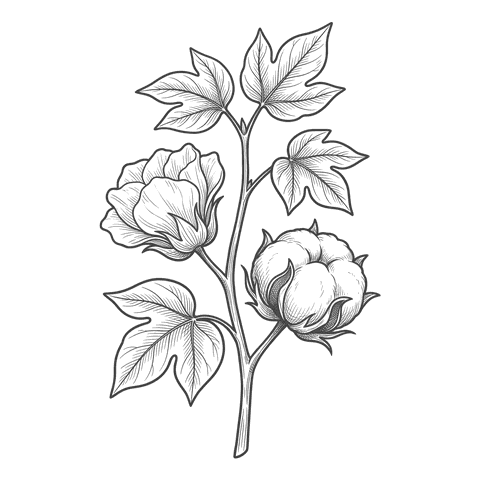
Cotton
Cool, breathable and surprisingly hard-wearing, cotton is the classic of the in-between seasons. It has no elasticity and is heavy when wet: the fabric drapes and tends to grow, but colours stay vivid and the handle is gentle even on sensitive skin.
Translated from Italian. A native knitter has not reviewed this translation yet.
History
Grown for millennia in the Indus Valley and ancient Egypt, cotton became the engine of the Industrial Revolution with Whitney's gin (1793), which made separating the fibre from the seeds fast. A textile turning point came in 1844 with John Mercer's mercerisation: treatment in caustic soda gives the yarn a silky lustre, greater strength and a more intense uptake of colour. The indigo of denim remains its most recognisable colour legacy.
How the yarn is made
After picking, ginning separates the fibre from the seeds; then comes carding, or the more refined combing for smooth, strong yarns. Spinning can be ring spinning (ring-spun, a more even and softer yarn) or open-end (cheaper and bulkier). Mercerisation is an optional step that enhances lustre and brilliance. The count is typically expressed in Ne, the English cotton count.
Why it is prized
It is the fibre of coolness: it absorbs moisture and releases it, stays pleasant to the touch even in the heat and is well tolerated by sensitive skin. Unlike animal fibres it gets stronger when wet, so it stands up to frequent and vigorous washing. Its full handle and vivid colours make it the natural choice for summer knitwear.
Dyeing
Excellent, but with a different chemistry from wool: cellulose does not bind acid dyes, and is dyed instead with reactive, direct or vat dyes, such as the historic indigo. Mercerisation opens up the fibre and brings out brighter, fuller colours. Fastness is good, with deep results especially on combed and treated yarns.
Care
Hard-wearing and washable even in hot water, cotton does not mind agitation and does not felt. At the first wash some relaxation shrinkage from spinning tensions is normal, so it is worth pre-washing the skein or the swatch before working out measurements. It creases easily and, in long garments, the wet weight can make it stretch: better to dry it flat.
End of life
A biodegradable plant fibre, pure cotton breaks down without leaving microplastics. It can be mechanically recycled, although shredding shortens the staple and lowers the quality of the regenerated fibre. Its man-made relatives, viscose and lyocell, come from the same cellulose.
How to recognise it
| Hand | Cool to the touch, soft but "flat" and with no elastic spring. When mercerised it feels smoother, more compact and lustrous. |
|---|---|
| Look | Naturally matt, bright when mercerised, with no visible crimp: it is precisely the absence of crimp that explains its lack of elastic memory. |
| Behaviour | It drapes and tends to grow under its own weight, creases easily, holds little warmth and is stronger wet than dry. |
| Burn test | Cellulosic signature: it burns quickly with a yellow flame, smells of burning paper or leaves, leaves an afterglow, and a light, soft grey ash. |
| Home tests | Burn test: quick flame, paper smell, lingering afterglow and soft ash · Wet stretch test: cotton gets stronger, animal fibres get weaker · Crease test: it folds and stays folded, without springing back |
| Confused with | Linen and hemp: same burn signature, but cooler, stiffer and even more prone to creasing · Viscose: cellulosic like cotton and similar in the flame, but more lustrous and much weaker when wet |
| Only in a lab | Telling cotton apart from other cellulosics (linen, viscose) requires microscopy, while the exact composition of blends is determined by ISO 1833 chemical separation. |
Physical facts
| Property | Value | Source |
|---|---|---|
| elastic memory | None | research |
| sag | High (very heavy when wet) | research |
| halo | None | research |
| felting risk | None | research |
| fineness (µm) | — | research |
| moisture regain (%) | 8.5 | measured |
| typical shrinkage (%) | 3–8 | estimate |
| staple length (mm) | 10–40 | measured |
measured = a measurement with a reference · iso = a standard · research = a verified source · estimate = plausibility only
For the fabric engine
| friction coefficient (µ) | 0.29 | measured |
|---|---|---|
| density (g/cm³) | 1.52 | measured |
| Young's modulus (GPa) | 8.0 | measured |
| specific bending stiffness (dyn·cm²/tex²) | 0.53 | measured |
Good for
summer and in-between-season garments · knits with good drape · sensitive skin and babies · vivid colours and denim · garments washed often
Less good for
ribs and cuffs that must spring back (they give without elastane) · garments that must hold warmth · very long garments at risk of stretching