
Fibres · Animal
Yak
The warmth of cashmere with a character that is both rustic and noble. It comes from the soft undercoat of the high-altitude yak, has deep natural colours and knits like a good wool: soft, warm and surprisingly easy-going.
Translated from Italian. A native knitter has not reviewed this translation yet.
History
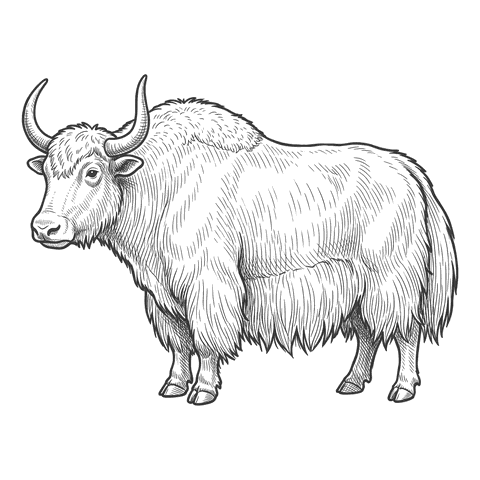
For the nomadic herders of the Tibetan plateau and the Mongolian steppes, the yak has always been a pack animal and a source of milk and fibre. The treasure is not the long, coarse outer hair but the very fine undercoat the animal grows to survive winters at extreme temperatures, called khullu. Long a household fibre for the herders' own use, today it is promoted by Himalayan and Mongolian cooperatives as an ethical, local and traceable alternative to cashmere.
How the yarn is made
During the spring moult the undercoat is combed out or gathered by hand, never shorn together with the coarse hair. Then comes dehairing, the same mechanical separation used for cashmere, which removes the coarse guard hairs and leaves only the fine fibre. The result is a short, soft fibre that lends itself above all to soft, lofty woollen-spun yarns.
Why it is prized
It offers cashmere-like warmth at a lower cost and with a smaller environmental impact. The fibre is fine but sturdier than the average luxury fibre of the same fineness, which makes it less delicate than its softness suggests. Add to this the value of a short, low-impact high-altitude supply chain, which makes it an increasingly sought-after choice among discerning knitters.
Dyeing
Being a protein fibre, it takes acid dyes well, with good fastness. Its most typical trait, though, is its natural colour: warm browns, deep greys and charcoal that you rarely want to cover. The dark pigmentation limits light, bright shades, so yak shows at its best in its original earthy tones.
Care
Treat it with the same care as cashmere: hand wash or a wool cycle in cold water, neutral detergent and flat drying so the garment does not lose its shape. The fibre is scaly, so with heat, moisture and friction it tends to felt. Pilling is limited but present on very soft garments, and is handled with a dedicated comb.
End of life
It is a natural protein fibre, so it is biodegradable and compostable at end of life, as long as it is not blended with synthetics. Offcuts and worn garments can be mechanically recycled together with other luxury fibres to regenerate new woollen-spun yarn.
How to recognise it
| Hand | Soft, warm and dry to the touch, slightly less silky than cashmere but fuller and with more body. It is not slippery: it gives an enveloping, slightly rustic feel. |
|---|---|
| Look | Matte, with warm, deep natural colours (brown, grey, charcoal) and a soft, discreet halo. Lustre is minimal; its character is that of a noble but understated fibre. |
| Behaviour | Very warm and light, with medium elasticity: it returns to shape reasonably well, without merino's bounce. It wrinkles little and is hard-wearing for such a fine fibre. |
| Burn test | Protein signature: burns slowly and self-extinguishes, smells of burning hair, and leaves a small black, crumbly bead. |
| Home tests | Burn test: slow flame, goes out by itself, crumbly ash · Dark, warm natural colour, hard to achieve with dyeing · Hand similar to cashmere but slightly less yielding and fuller |
| Confused with | Cashmere: very similar fineness, often sold as a yak/cashmere blend; almost indistinguishable by hand · Fine merino wool: but yak is less springy and has the typical dark natural colour |
| Only in a lab | Telling yak apart from cashmere with certainty requires laboratory electron microscopy (ISO 17751), which reads its scale structure and pigmentation. |
Physical facts
| Property | Value | Source |
|---|---|---|
| elastic memory | Medium | research |
| sag | Low | research |
| halo | Medium | research |
| felting risk | Medium | research |
| fineness (µm) | 16–20 | research |
| moisture regain (%) | 16.0 | research |
| typical shrinkage (%) | 0–8 | estimate |
| staple length (mm) | 25–45 | research |
measured = a measurement with a reference · iso = a standard · research = a verified source · estimate = plausibility only
Good for
warm, light layers · blends with merino or cashmere · garments in deep natural colours · soft winter knitwear
Less good for
high-abrasion garments (cuffs of work jackets) · ribs that need to bounce back like merino · light, bright pastel shades