
Fibres · Animal
Classic / Rustic Wool
Honest wool without frills: springy, sturdy and warm, a little lively on the skin. It has the character of its breed and holds up very well in structured garments, but it felts at the slightest provocation, so watch the wash.
Translated from Italian. A native knitter has not reviewed this translation yet.
History
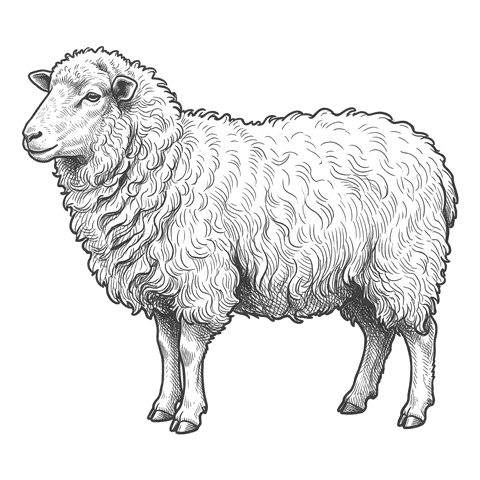
This is the wool of "terroir": before uniform industrial yarns, every flock gave a fibre with its own fineness, lustre and colour, tied to breed and pasture. From this variety come the historical fabrics of the British Isles, from tweed to island sweaters, and the heritage of Italy's native breeds, now partly revived by conservation projects and short supply chains against the risk of extinction.
How the yarn is made
It comes from shearing the fleece and is often woollen-spun to bring out the bulk, air and character of the fibre. Many of these wools are single-breed, that is, not blended: the yarn tells of a specific sheep instead of levelling everything into an industrial average. Where the staple is long and lustrous, combing gives smoother, more compact and stronger yarns.
Why it is prized
It is valued for character, not for extreme softness: it gives hold, structure and a clear elastic memory, perfect for knits that need to keep their shape over time. Each breed brings a different trait (a lustre, a natural colour, a rustic note), and choosing it means supporting biodiversity and the small supply chains that process it.
Dyeing
Very good dyeability: keratin binds acid dyes firmly, with full, fast results. Many of these wools, however, have beautiful natural colours (greys, browns, fawn, black) and are happily used undyed, playing on the breed's own palette.
Care
Sturdy but touchy with water: agitation, heat and moisture make it felt quickly, often more than merino. Hand wash or use a wool cycle in cold water with a gentle detergent, and dry flat so it does not lose its shape. The same tendency to full becomes an asset when felting is intended.
End of life
Biodegradable and compostable when not superwash-treated. It can be mechanically recycled: regenerated woollen fibre makes new fibre, and Prato is its historical capital. Coarse wools, unsuited to fine knitwear, find a second life as stuffing, felt or insulation.
How to recognise it
| Hand | Very variable by breed: from soft, gentle fibres (Bluefaced Leicester, Shetland) to lively, rough carpet wools. On average it is more rustic and springier than merino, warm to the touch and with a bit of grip under the fingers. |
|---|---|
| Look | Crimp and lustre change a lot from breed to breed: lustre wools are long and glossy, others matte and lofty. Natural undyed colours, typical of the original flock, are common. |
| Behaviour | It returns to shape after stretching and holds warmth well; long, lustrous fibres give a fabric with more hold and less pilling, short woollen-spun ones more air and softness. |
| Burn test | Protein signature: burns slowly and self-extinguishes, smells of burning hair, and leaves a small black, crumbly bead. |
| Home tests | Burn test: slow flame, goes out by itself, crumbly ash · Wet stretch test: wool weakens when wet, plant fibres do not · Natural colour and hand of the yarn as a clue to the breed |
| Confused with | Merino: rustic wools are generally coarser and less soft · Acrylic imitating them: but in the flame it melts into a hard bead and feels cold to the touch · Between different breeds: hard to tell apart by eye |
| Only in a lab | Identifying the breed with certainty and measuring microns requires laboratory microscopy (ISO 17751), sometimes alongside genetic analysis: values vary enormously from one breed to another. |
Physical facts
| Property | Value | Source |
|---|---|---|
| elastic memory | High (structural) | research |
| sag | Low | research |
| halo | Low | research |
| felting risk | Very high | research |
| fineness (µm) | 24–38 | research |
| moisture regain (%) | 17.0 | iso |
| typical shrinkage (%) | 0–12 | estimate |
| staple length (mm) | 60–200 | research |
measured = a measurement with a reference · iso = a standard · research = a verified source · estimate = plausibility only
Good for
rustic, structured knitwear · tweed and jackets · garments that need to hold their shape · intentional felting · showcasing native breeds
Less good for
direct contact with sensitive skin (the coarser ones prickle) · fluid, cool drape (silk or linen is better) · garments to be machine-washed often