
Fibres · Man-made
Viscose / Rayon
The fibre that pours like a liquid: lustrous, cool and very fluid, it takes colour brilliantly and drapes beautifully. In exchange it has no hold at all and becomes weak when wet, so use it where you want softness and movement, not structure.
Translated from Italian. A native knitter has not reviewed this translation yet.
History
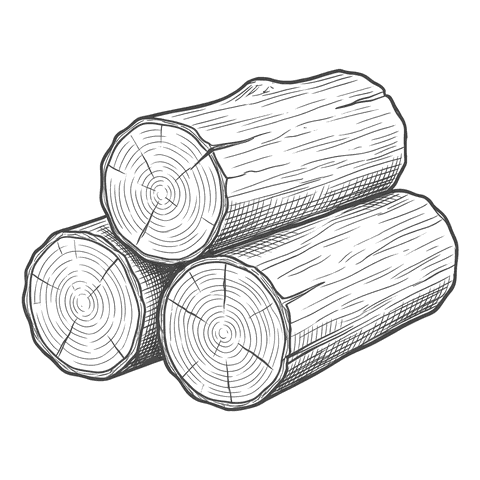
It was born at the end of the nineteenth century as the first successful attempt at "artificial silk": European chemists learned to dissolve and regenerate wood cellulose, and in 1905 the viscose process went into industrial production in Britain. The trade name rayon spread in the 1920s, when the fibre brought the luxury of silk within reach at an affordable price. Today production is led by large European and Asian cellulose groups, with closed-loop and certified-wood versions as a cleaner evolution of the historical chemistry.
How the yarn is made
It is neither shorn nor harvested: it is manufactured. Cellulose, usually from wood pulp (beech, eucalyptus, pine), is treated chemically until it becomes a thick solution, viscose, then forced through a spinneret and regenerated into filament in an acid bath. The continuous filament can be used as it is, glossy and smooth like silk, or cut into staple and spun like cotton for a duller, more cotton-like hand.
Why it is prized
It gives knitwear something elastic fibres cannot: a fluid, heavy, cool drape that falls straight and follows the body instead of puffing out. It is smooth, bright and pleasantly cool on the skin, absorbs moisture well and dyes with a brilliance that is hard to match. It is the fibre of movement and cascade, often blended with others to add lustre and swing.
Dyeing
Excellent, and one of its strengths. Being pure cellulose it absorbs reactive and direct dyes deeply, with saturated, full and very bright colours thanks to the smooth, glossy surface of the filament. Its colour yield is among the most vivid of all knitting fibres.
Care
This is the fibre that needs the most care. When wet it loses much of its strength and stretches easily, so hand wash it in cold water, without wringing or twisting, and dry it strictly flat, because hung up it distorts and stretches under its own weight. It tends to wrinkle and can shrink at the first wash: it is best to soak a test swatch before committing to a large garment.
End of life
Being regenerated cellulose, it is biodegradable and compostable in suitable conditions, unlike petroleum-based synthetics. The critical point is not the fibre but the production chemistry: closed-loop supply chains using wood from responsibly managed forests clearly reduce the footprint, and those are the ones to look for.
How to recognise it
| Hand | Smooth, slippery and cool, almost cold at first touch like silk. It falls heavily between your fingers and has no elastic snap at all: it slumps gently. |
|---|---|
| Look | Lustrous and bright, with a silky sheen if it is continuous filament, duller and more cotton-like if spun from staple. No crimp, no halo: the surface is clean and smooth. |
| Behaviour | It drapes in a fluid, liquid way, falls straight and follows the body. It does not return to shape after stretching, wrinkles easily and when wet weakens and stretches visibly. |
| Burn test | Cellulosic signature: burns quickly with a lively flame, smells of burning paper or wood, and leaves light, crumbly grey ash with no melted bead. |
| Home tests | Burn test: quick flame, smell of burning paper, crumbly ash with no hard bead · Wet stretch test: when wet it stretches and gives a lot, whereas animal fibres hold up better · Drape test: it falls plumb like a liquid, with no elastic bounce |
| Confused with | Silk, which it imitates in lustre and coolness: but wet silk stays much stronger and in the flame has the protein smell of burning hair · Cotton and other cellulosics, with which it shares the burn test: viscose stands out for its greater lustre and more fluid fall |
| Only in a lab | Separating viscose from other cellulosic fibres (cotton, linen, lyocell, modal) with certainty and quantifying its share in a blend requires laboratory analysis (microscopy and selective solubility, ISO 1833). |
Physical facts
| Property | Value | Source |
|---|---|---|
| elastic memory | None | research |
| sag | Extreme (very fluid) | research |
| halo | None | research |
| felting risk | None | research |
| fineness (µm) | — | research |
| moisture regain (%) | 13.0 | research |
| typical shrinkage (%) | 3–10 | estimate |
| staple length (mm) | — | research |
measured = a measurement with a reference · iso = a standard · research = a verified source · estimate = plausibility only
For the fabric engine
| friction coefficient (µ) | 0.3 | measured |
|---|---|---|
| density (g/cm³) | 1.52 | measured |
| Young's modulus (GPa) | 8.5 | measured |
| specific bending stiffness (dyn·cm²/tex²) | 0.19 | measured |
Good for
garments with a fluid, falling drape · soft tops and dresses that follow the body · blends to add lustre and swing · summer knitwear that feels cool to the touch
Less good for
ribs and cuffs that need to hold their shape · structured, load-bearing garments · projects that will be stretched and strained while wet