
Fibres · Animal
Vicuña / Guanaco
The rarest and most precious fibre in the world: very warm, light and so soft it feels like a caress. A luxury to save for exceptional comfort garments, where the hand matters more than elastic performance.
Translated from Italian. A native knitter has not reviewed this translation yet.
History
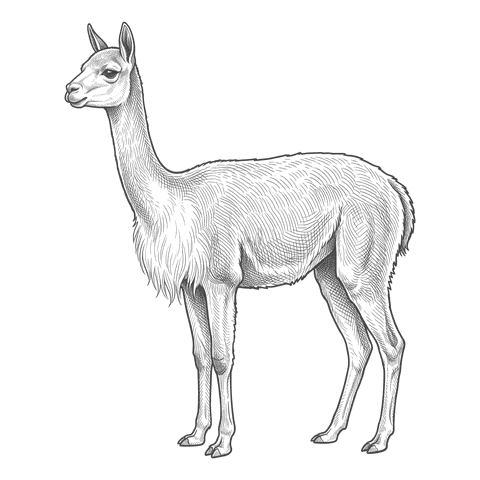
In the Andes the vicuña was the "fibre of the gods", reserved for the Inca: anyone who was not royalty could not wear it. Indiscriminate hunting brought it close to extinction, until international protection and community shearing programmes (the chaccu, the ancient round-up of capture and release) restored its populations. The guanaco, its more widespread wild cousin, gives a sister fibre that is slightly coarser. Today they remain among the most expensive yarns of all, tied to traced Andean supply chains and a handful of luxury houses.
How the yarn is made
The animals are wild: they are caught alive, shorn by hand and released, with a tiny fleece yield every two or three years. The very short, fine fibre has to be freed from the coarser guard hair (dehairing), then combed or carded with extreme care. Processing is almost artisanal: every gram is precious and spinning runs to very fine counts.
Why it is prized
It combines extreme fineness with a medullated shaft that traps air: it is warmer than almost any other fibre while staying very light, and it is softer than cashmere to the touch. Its natural rarity, together with a tiny yield per garment, puts it at the top of the pyramid of luxury fibres. In knitwear it is chosen for hand and warmth, not for holding shape.
Dyeing
It is rarely dyed, and not easily. The natural colour, from warm hazel to chocolate, is so beautiful and distinctive that most garments are left undyed or only lightened. When it is dyed it needs acid dyes and very expert hands, so as not to damage such a delicate fibre or dull its warm glow.
Care
A fragile fibre with low memory: treat it like a jewel. Only cold hand washing with a neutral detergent or professional dry cleaning, strictly flat drying, and rest between wears so it can recover its shape. It tends to bloom and to form light surface pilling where it rubs: refresh it gently, never rubbing.
End of life
A pure protein fibre, biodegradable and compostable at end of life when not blended with synthetics. Its very high value makes it an ideal candidate for upcycling: garments and offcuts are recovered and sent back to spinning instead of being thrown away.
How to recognise it
| Hand | Silky, warm and impalpable, softer than cashmere and almost without elastic body: it runs through your fingers like face powder. |
|---|---|
| Look | Warm natural colour, from tawny to brown, with a discreet, velvety lustre. The crimp is weak and the garment tends to develop a soft halo of bloom on the surface. |
| Behaviour | It drapes softly and warmly, but returns to shape slowly: under tension it gives and does not bounce back. It is extremely warm for its weight and wrinkles little. |
| Burn test | Protein signature: burns slowly, self-extinguishes, smells of burning hair and leaves a small black, crumbly bead. |
| Home tests | Burn test: slow flame, goes out by itself, crumbly ash · Hand and warmth: exceptionally soft and warm for its weight · Stretch test: it gives and returns to shape slowly, it does not bounce back like wool |
| Confused with | Cashmere: similar hand, but vicuña is finer still, warmer and has the typical natural tawny colour · High-end light baby alpaca, which imitates its hand and tone at a much lower cost |
| Only in a lab | Telling vicuña, guanaco and cashmere apart with certainty and measuring their microns requires laboratory microscopy (ISO 17751); the hand alone fools even experts. |
Physical facts
| Property | Value | Source |
|---|---|---|
| elastic memory | Low | research |
| sag | Medium | research |
| halo | High | research |
| felting risk | Medium | research |
| fineness (µm) | 12–15 | research |
| moisture regain (%) | 15.0 | research |
| typical shrinkage (%) | 0–8 | estimate |
| staple length (mm) | 30–50 | research |
measured = a measurement with a reference · iso = a standard · research = a verified source · estimate = plausibility only
Good for
exceptional comfort garments · very light scarves and stoles · fine knitwear worn next to the skin · luxury accessories · warm, thin layers
Less good for
ribs and cuffs that need to hold their shape · garments subject to heavy wear · structured elastic knitwear · bright, vivid shades