
Fibres · Regenerated
Soy (Vegetable silk)
The "vegetable silk": soft, lustrous and with a fluid drape that glides over the body. It is made from soy proteins, has very little elastic memory and tends to stretch out, so it does best in soft garments rather than taut edgings.
Translated from Italian. A native knitter has not reviewed this translation yet.
History
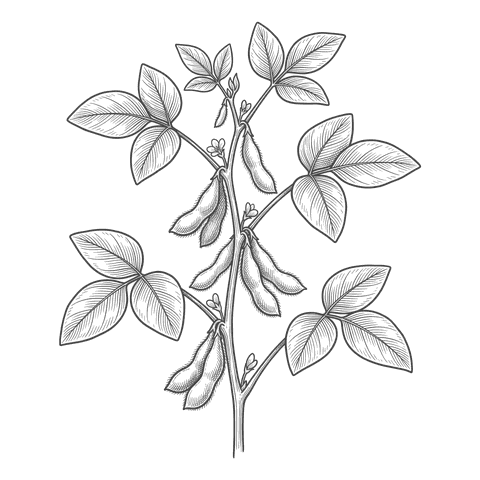
The idea of spinning soy protein is an old one: in the 1930s and 1940s Henry Ford turned it into a textile fibre and even had a demonstration suit made from it. The modern fibre, however, is Chinese: developed in the late 1990s and sold from 2000 as "vegetable cashmere", it recovers the proteins extracted from soybean cake, the by-product of oil and tofu production, giving them a second life as yarn.
How the yarn is made
It is neither shorn nor harvested: it is extruded. The protein is isolated from soybean cake, dissolved into a solution, spun through a spinneret into a coagulation bath and then stabilised. The result is a continuous filament, which can be used as it is or cut into staple to be combed and blended with other fibres. It is to all intents and purposes a regenerated protein fibre, not a thread drawn directly from the plant.
Why it is prized
It combines qualities that rarely go together: the lustre and cool hand of silk, the softness of cashmere and excellent moisture absorption. It is light, breathable and very pleasant on the skin, and for this reason it is often blended with wool, cotton or cashmere to lighten them and add lustre and drape.
Dyeing
Good. Being a protein fibre, like wool and silk it binds acid dyes well and gives deep, bright shades; it also accepts the reactive dyes used for plant fibres. The result is brilliant, but very strong shades should be protected from light, because the fibre tends to yellow over time.
Care
Handle it gently: hand wash or a delicate cycle in cold water, neutral detergent, no bleach and no vigorous wringing. Dry flat, away from direct sun so it does not yellow. With little elastic memory, if hung up wet it stretches and does not come back. It does not felt, but in soft blends it may form a few pills.
End of life
It is biodegradable, because it is made of protein: in suitable conditions it decomposes without leaving microplastics. Mechanical recycling is possible mainly for pure soy yarns, while in blends with wool or cashmere it is hard to separate. Its environmental merit from the start is that it comes from recovered food waste.
How to recognise it
| Hand | Very soft and cool, with a silky, slightly slippery glide. To the touch it is warmer than real silk and smoother than cotton. |
|---|---|
| Look | Fairly lustrous, with a soft, even sheen reminiscent of silk; no visible crimp and practically no halo. The colour looks full and bright. |
| Behaviour | It falls fluidly and drapes well, wrinkles moderately, but after stretching it does not return to shape: its low elastic memory gives it away. It absorbs moisture well and stays cool. |
| Burn test | Protein signature, like wool and silk: burns slowly, tends to self-extinguish, smells of burning hair or feathers and leaves dark, crumbly ash, with no hard bead. |
| Home tests | Burn test: slow flame, self-extinguishes, smell of burning hair and crumbly ash · Elasticity test: stretch and release; it stays stretched instead of returning to shape · Hand test: cool, slippery and lustrous, but without the crunching sound of silk |
| Confused with | Real silk, which it imitates in lustre, but silk is more elastic, cooler and more expensive · Viscose and bamboo fibre, just as lustrous and soft but with a cellulosic signature in the flame · Milk fibre (casein), another regenerated protein fibre almost indistinguishable by hand |
| Only in a lab | Telling soy apart from other regenerated protein fibres and from silk with certainty requires laboratory microscopy and chemical analysis (ISO 17751, ISO 1833). |
Physical facts
| Property | Value | Source |
|---|---|---|
| elastic memory | Low | research |
| sag | High (fluid drape) | research |
| halo | Low | research |
| felting risk | None | research |
| fineness (µm) | — | research |
| moisture regain (%) | 8.6 | research |
| typical shrinkage (%) | 0–5 | estimate |
| staple length (mm) | 38–51 | research |
measured = a measurement with a reference · iso = a standard · research = a verified source · estimate = plausibility only
Good for
fluid garments with drape · summer tees and tops · soft, lustrous scarves · blends that add lustre and softness · garments worn directly against the skin
Less good for
ribs and cuffs that need to stay snug · highly structured garments · edgings that need to spring back · dark shades meant for strong sun exposure