
Fibres · Plant
Sisal / Agave
The hard fibre par excellence: stiff, tough and structural, it does not spring back and is not meant for the body. You choose it when an object needs to hold its shape on its own, like baskets, rugs and rigid bags.
Translated from Italian. A native knitter has not reviewed this translation yet.
History
It takes its name from the port of Sisal, in Mexico's Yucatán, from which the first cargoes of agave fibre set sail. From Central America cultivation spread to East Africa, where Tanzania and Kenya became the great producing centres of the twentieth century, and to Brazil, today the world's largest exporter. For generations it was the fibre of rope and baler twine, before its rustic character brought it into furnishings and design accessories.
How the yarn is made
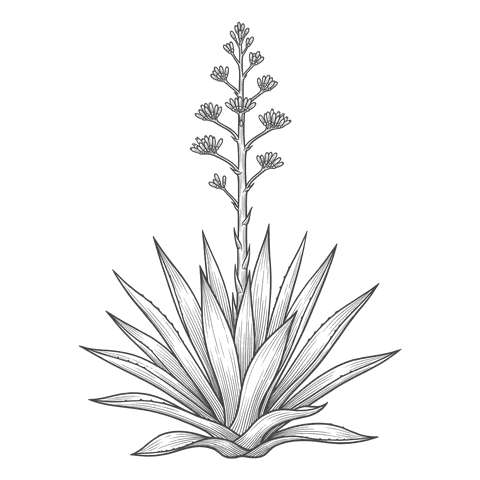
It is not shorn and no fibre is sown: it is cut. The fleshy agave leaves are harvested and decorticated, a process that scrapes away the pulp and frees long bundles of fibre. These are washed, dried in the sun and brushed, then twisted into cords and bulky yarns. It is long, strong-fibre processing, closer to rope-making than to fine spinning.
Why it is prized
It is valued for what wool cannot do: stiffness and hold. It is one of the toughest natural fibres, does not give under load and keeps the geometry you give it, so a basket stays open and a bag does not slump. It also resists abrasion and foot traffic well, which is why it has always been the fibre for rugs.
Dyeing
Being cellulosic, it accepts direct and reactive dyes, but its hard surface and natural straw-gold tone mute brightness: the best results remain earthy, natural and warm shades. Indeed many pieces are left in the raw colour, which is part of their rustic look.
Care
It does not like prolonged damp: if it stays wet it can stain, yellow and go mouldy, and over time it degrades. Clean it dry, brushing off dust and blotting stains without soaking, and keep it away from humid rooms. With use it tends to shed a light surface fuzz, normal for such a stiff fibre.
End of life
Entirely plant-based and untreated, it is biodegradable and compostable, and at end of life it returns to the soil without leaving microplastics. Decortication waste has traditionally been reused as organic matter and for making paper and composite materials.
How to recognise it
| Hand | Hard, rough and dry, almost woody. Cold and stiff to the touch, with no give at all: it feels like it "stands up" between your fingers rather than soft. |
|---|---|
| Look | Natural straw-gold colour with a slight waxy lustre. Thick, wiry yarn with a rustic look, with no crimp and no halo. |
| Behaviour | It has no elastic recovery: folded it stays folded, and under tension it does not bounce back. It is stiff, strong in tension and very resistant to abrasion, but brittle under repeated folding. |
| Burn test | Cellulosic signature: burns quickly with a lively flame, smells of burning paper or grass, and leaves light grey ash that crumbles. |
| Home tests | Burn test: quick flame, smell of burning paper, crumbly ash · Stiffness test: a short cord stands straight on its own, it does not flop · Wet stretch test: the plant fibre does not weaken the way protein wool does |
| Confused with | Jute and hemp: also hard plant fibres, but softer and less stiff to the touch · Raffia: similar in colour and rusticity, but a flat ribbon and much more flexible |
| Only in a lab | Telling sisal apart from other hard plant fibres (jute, hemp, abaca) with certainty requires laboratory microscopy (ISO 17751) or chemical fibre analysis (ISO 1833). |
Physical facts
| Property | Value | Source |
|---|---|---|
| elastic memory | None | research |
| sag | Low | research |
| halo | None | research |
| felting risk | None | research |
| fineness (µm) | 100–300 | research |
| moisture regain (%) | 11.0 | research |
| typical shrinkage (%) | 0–3 | estimate |
| staple length (mm) | 600–1200 | research |
measured = a measurement with a reference · iso = a standard · research = a verified source · estimate = plausibility only
Good for
baskets and rigid containers · rugs and mats · bags and structured accessories · rope and twine · sturdy decorative details
Less good for
garments worn next to the skin · elastic knitwear and ribs · soft drape · objects that need to stay soft