
Fibres · Animal
Tussah Silk (Raw/Wild Silk)
The rustic, wild silk: less slippery and less glossy than classic silk, but with a warm golden sheen and more body. It has no elasticity at all, yet it gives lustre and a hand with character, already coloured by nature.
Translated from Italian. A native knitter has not reviewed this translation yet.
History
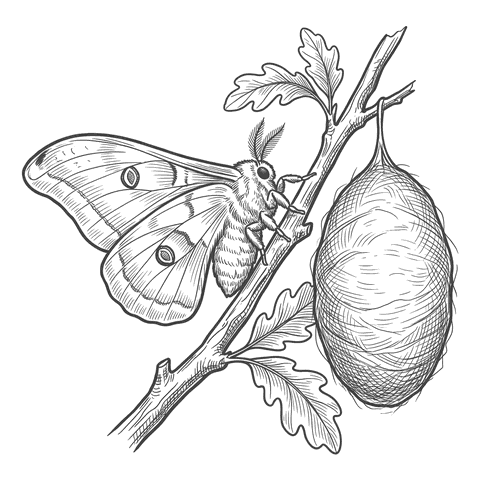
It comes from the cocoons of wild moths that live freely on oaks and other trees, not from the silkworm raised on mulberry. In India the tasar tradition is very old and tied to the tribal forests of Jharkhand and Bengal; in China and Korea oak silk (from the pernyi moth) has been used for centuries in the sturdiest household fabrics. Unlike mulberry sericulture, gathering here largely follows the cycles of the forest: it is a simpler, rural silk rooted in its land.
How the yarn is made
Wild cocoons are often collected after the moth has already emerged, which breaks the continuous filament: that is why Tussah is frequently degummed and spun like a short fibre (spun silk) rather than reeled as a continuous filament like mulberry silk. The diet of tannin-rich oak leaves is what gives it its characteristic natural golden-beige colour. The degree of degumming decides how much gum stays on the thread, and so how much body and rusticity it keeps.
Why it is prized
It offers the lustre of silk with a more textural personality: a warm sheen, a golden colour ready without dyeing and more body that holds the shape of the stitch better. It is cool and breathable like any silk, but less cold and less elusive to the touch, so it is easier to work for those who find classic silk too slippery. It is also a wild-harvested fibre, valued by those looking for low-impact materials.
Dyeing
It takes acid dyes well, as protein fibres do, but it starts from a golden-beige base that warms and mutes the shades: light, cool colours shift towards warm, earthy tones, while deep shades come out beautifully. For this very reason Tussah is often left in its natural colour, which is already one of its qualities.
Care
It is a delicate protein fibre: hand wash in cold water with a neutral detergent, avoiding strong alkalis and chlorine bleach, which yellow and weaken it. Keep it away from prolonged direct light and dry it flat in the shade. Water drops can leave marks on the surface, so wet the garment evenly. It does not felt or pill, but with no elastic memory a garment under heavy strain tends to lengthen.
End of life
It is a natural protein, biodegradable and compostable when not blended with synthetic fibres. Being wild-harvested and often undyed, it has a particularly clean end of life; spinning waste is recovered as short fibre.
How to recognise it
| Hand | Cool but less cold than mulberry silk, clearly less slippery and drier to the touch. It has a slight texture and a body you feel at once between your fingers, without the elusiveness typical of classic silk. |
|---|---|
| Look | Natural golden-beige or ecru colour, with a warm, subdued lustre, never mirror-like. The yarn is often slightly irregular, with small variations and slubs that tell of its wild origin. |
| Behaviour | It falls with more body and less fluidity than mulberry silk, and it has no elastic recovery at all: once stretched, it stays stretched. It tends to wrinkle, holds moderate warmth and is very breathable. |
| Burn test | Protein signature: burns slowly and tends to go out by itself, smells of burning hair or feathers, and leaves a brittle black bead that crumbles. |
| Home tests | Burn test: slow flame, goes out by itself, smell of burning hair, crumbly ash · Dry hand: less slippery and more textural than mulberry silk · Natural golden colour: the warm beige comes not from dyeing but from the oak diet |
| Confused with | Mulberry silk (Bombyx): whiter, finer, glossier and more slippery · Viscose or other regenerated fibres imitating silk: in the flame they smell of paper and leave light ash, not the protein bead · Raw linen, for its ecru colour and dry hand, but in the flame linen has a cellulosic signature |
| Only in a lab | Telling Tussah apart from mulberry silk with certainty and measuring its fineness requires laboratory microscopy: the Tussah cross-section is wider, flatter and finely striated compared with the smooth mulberry fibre (ISO 17751). |
Physical facts
| Property | Value | Source |
|---|---|---|
| elastic memory | None | research |
| sag | Medium (less slippery) | research |
| halo | None | research |
| felting risk | None | research |
| fineness (µm) | 25–40 | research |
| moisture regain (%) | 11.0 | research |
| typical shrinkage (%) | 0–5 | estimate |
| staple length (mm) | — | research |
measured = a measurement with a reference · iso = a standard · research = a verified source · estimate = plausibility only
Good for
garments with warmth and body · matte, golden surfaces · summer knitwear with structure · rustic, textural surfaces · knitters who find classic silk too slippery
Less good for
elastic ribs and cuffs · perfectly pure light, cool colours · the smooth, mirror-like hand of mulberry silk · garments that need to spring back