
Fibres · Animal
Silk
The fibre of lustre and drape: cool, strong and sumptuous, it slides and falls like no other. It has no elasticity and does not spring back, so it goes where you lead it, bright and fluid.
Translated from Italian. A native knitter has not reviewed this translation yet.
History
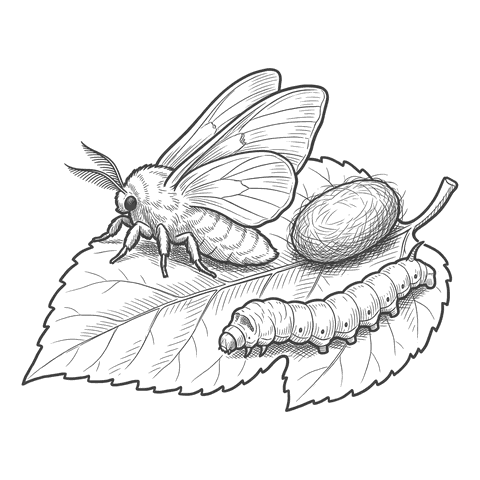
It was born in China, where for thousands of years its production was a state secret, protected by the death penalty for anyone who revealed it. Along the Silk Road it became currency, luxury and diplomacy before reaching Europe. Mulberry silk gives the finest and most even filament; tussah, raised on oaks in the wild, is more rustic and amber-toned. In Italy the Como district is still a world reference for silk weaving and finishing.
How the yarn is made
It is obtained by reeling the cocoon: a single continuous filament, hundreds of metres long, is unwound in hot water once the sericin that glues it together has softened. This is almost unique among natural fibres, which are nearly all short staple. Several filaments are combined and twisted to form the thread, whose count is given in denier. Waste silk and broken cocoons are carded and spun from staple, giving spun (schappe) silk, which is duller and velvety.
Why it is prized
It brings together qualities that rarely coexist: deep lustre, fluid drape, high tensile strength and a cool hand. In knitwear it ennobles blends, because it adds sheen, fall and colour brilliance where wool and cashmere would give only warmth and bulk. Silk-cashmere and silk-merino are classics precisely because of this balance.
Dyeing
Excellent. Being a protein fibre like wool, it binds acid dyes with very high brilliance and depth of shade, enhanced by the smooth filament that reflects light. It has a long tradition of fine dyeing and vivid colours; dark, saturated shades come out particularly well.
Care
It needs gentle care: hand wash in cool water with a neutral detergent, no bleach and no aggressive spinning. It is damaged by direct light, which yellows it and makes it brittle, and by sweat and deodorants, which stain and corrode it. Even a drop of water can leave a mark, so wet it evenly. It does not felt, because the filament is smooth.
End of life
It is a natural protein, so it is biodegradable and compostable when not blended with synthetic fibres or weighted with finishes. Thanks to the strength of the thread it lends itself to reuse and tailored upcycling; mechanical recycling is possible but not widespread on an industrial scale.
How to recognise it
| Hand | Very smooth and slippery, cool at first touch and then quick to warm with the skin. Its unmistakable trait is scroop: the crunch, almost a rustle, you hear when you rub two pieces together. |
|---|---|
| Look | Intense, deep lustre, typical of continuous filament, with vivid colours and shimmering highlights. No crimp and no halo: the surface is compact and bright. |
| Behaviour | It drapes beautifully and falls fluidly, but it has no elastic recovery: pull it and it lengthens and stays, it does not bounce back. Very strong in tension when dry, it weakens when wet and is sensitive to UV light and sweat. |
| Burn test | Protein signature: burns slowly, tends to self-extinguish, smells of burning hair and leaves a small black, crumbly bead. In the flame it is practically indistinguishable from wool. |
| Home tests | Scroop test: rub two pieces together; silk crunches and rustles · Cool, glossy hand: cold and slippery at first, then it warms up quickly · Burn test: slow flame, goes out by itself, smell of burning hair, crumbly ash |
| Confused with | Viscose or rayon imitating it: but they are cellulosic, burn to paper-like ash, are weaker when wet and colder to the touch · Shiny polyester: but in the flame it melts into a hard bead and does not smell of burning hair |
| Only in a lab | Certain confirmation comes from microscopy: the silk filament is smooth with a triangular cross-section, and it is this prism shape that produces its lustre. Fine distinction from other protein fibres follows the ISO 1833 tests. |
Physical facts
| Property | Value | Source |
|---|---|---|
| elastic memory | None | research |
| sag | High (fluid/slippery) | research |
| halo | None | research |
| lustre | Lustrous | research |
| metallic | No | research |
| felting risk | None | research |
| fineness (µm) | — | research |
| moisture regain (%) | 11.0 | research |
| typical shrinkage (%) | 0–5 | estimate |
| staple length (mm) | — | research |
measured = a measurement with a reference · iso = a standard · research = a verified source · estimate = plausibility only
For the fabric engine
| friction coefficient (µ) | 0.26 | measured |
|---|---|---|
| density (g/cm³) | 1.34 | measured |
| Young's modulus (GPa) | 9.5 | measured |
| specific bending stiffness (dyn·cm²/tex²) | 0.19 | measured |
Good for
fluid, lustrous garments · fine blends with wool or cashmere · elegant summer knitwear · scarves and softly draped garments · colour brilliance
Less good for
ribs and cuffs that need to spring back (it is inelastic) · garments heavily exposed to sunlight or sweat · knitwear that must hold its own shape without sagging