
Fibres · Man-made
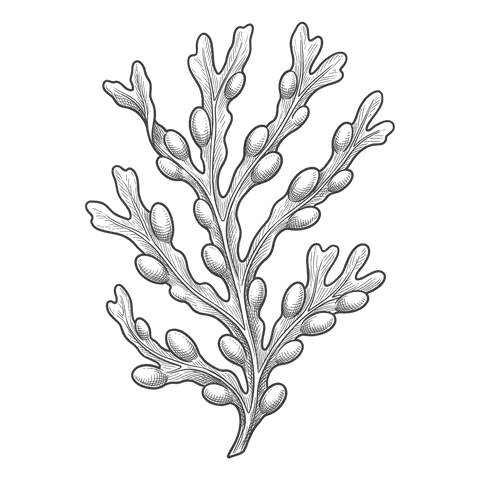
Seaweed (Seacell)
A lyocell enriched with brown seaweed: soft, cool and with a fluid drape that falls straight. It has little stretch and almost no memory, so it is the right fibre for light, flowing garments, not for ribs that need to bounce back.
Translated from Italian. A native knitter has not reviewed this translation yet.
History
It was born in Germany in the early 2000s, developed by smartfiber AG, which patented a way to incorporate dried, ground brown seaweed into a lyocell fibre. The seaweed is harvested by hand in the fjords of Iceland and Norway with a cut that leaves the regenerating part of the plant intact, so the bed grows back. It is a recent, niche fibre that nearly always appears blended with cotton or other lyocell in knitting yarns.
How the yarn is made
It is not spun from a natural staple like cotton: cellulose from wood is dissolved in a solvent and regenerated into filament with the closed-loop lyocell process, which recovers almost all of the solvent. During this stage the seaweed powder is added and stays embedded in the fibre. The filament is then cut into staple and spun, often blended with other cellulosic fibres.
Why it is prized
It combines the cool hand and beautiful fall of lyocell with the appeal of mineral-rich seaweed, although its benefits for the skin remain a producer's claim rather than textile data. Beyond the green angle, its real merit for knitters is textile: it is soft, breathable, very absorbent and has a fluid drape few plant-based yarns can give, all from a low-impact process compared with traditional viscose.
Dyeing
Excellent. Like all cellulosic fibres it takes reactive and direct dyes well, giving full, even, deep colours with good wash fastness. The fibre's soft sheen makes the shades bright and lively.
Care
Handle it gently: when wet the cellulosic fibre loses body and stretches, so wash in cold water, spin briefly and dry flat so it does not sag under its own weight. It does not felt and hardly fuzzes, but it can wrinkle and, under heavy abrasion, fibrillate slightly on the surface.
End of life
It is cellulose regenerated from a natural raw material: biodegradable and compostable when pure or blended with other natural fibres. Blending with synthetic fibres, on the other hand, complicates recycling and stops it returning to the soil.
How to recognise it
| Hand | Soft, smooth and slightly slippery, cool and almost cold at first touch like all cellulosics. It has no backbone: it folds without offering resistance. |
|---|---|
| Look | Soft, silky lustre, smooth and even surface. The fabric falls straight and compact, with almost no halo: no fluffy fuzz. |
| Behaviour | It drapes in a fluid, heavy way with very little elastic recovery: when stretched it tends to lengthen and stay that way. Cool to wear, very absorbent, it wrinkles moderately. |
| Burn test | Cellulosic signature: burns quickly with a bright yellow flame, does not self-extinguish, smells of burning paper or leaves, and leaves fine, light grey ash. |
| Home tests | Burn test: quick, steady flame, smell of burning paper, light ash · Wet stretch test: the fibre gives and lengthens, typical of cellulosics · Elasticity test: stretch and release; it does not return to shape |
| Confused with | Pure lyocell/Tencel and Modal, practically identical in the hand and in the flame · Viscose, but viscose weakens much more when wet · Mercerised cotton, for its cool sheen and compact fall |
| Only in a lab | Distinguishing this lyocell from other lyocells, from modal or from viscose, and above all confirming that the seaweed is present, requires laboratory microscopy and chemical analysis (ISO 1833). |
Physical facts
| Property | Value | Source |
|---|---|---|
| elastic memory | Low | research |
| sag | High (fluid drape) | research |
| halo | None | research |
| felting risk | None | research |
| fineness (µm) | — | research |
| moisture regain (%) | 11.5 | research |
| typical shrinkage (%) | 0–5 | estimate |
| staple length (mm) | 38–51 | research |
measured = a measurement with a reference · iso = a standard · research = a verified source · estimate = plausibility only
Good for
light, flowing garments · summer tops and tees worn next to the skin · soft, fluid drape · blends with cotton or other lyocell
Less good for
ribs and cuffs that need to spring back · structured, tightly knitted garments · projects that need elastic memory · high bulk and warmth