
Fibres · Plant
Ramie (China grass)
A glossier, brighter cousin of linen: cool, very light and remarkably strong, with an almost silky sheen. It has little stretch and is somewhat stiff, so it is at its best in summer garments that need to stay cool against the skin.
Translated from Italian. A native knitter has not reviewed this translation yet.
History
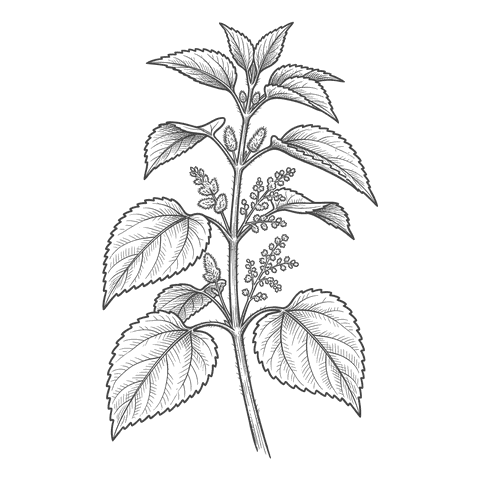
Also called "China grass", ramie is one of the oldest textile fibres: it has been woven in East Asia for thousands of years, and in Egypt it was used to wrap mummies. It comes from the stem of a perennial nettle without stinging hairs, grown mainly in China, still the world's largest producer, and then in the Philippines, Brazil and India. In the West it has remained a niche fibre, valued above all as a lustrous alternative to linen in yarns and for the in-between seasons.
How the yarn is made
It is a bast fibre, taken from the inner bark of the stem. After cutting, the stems are decorticated to strip off the fibrous ribbons, but raw ramie is full of gums and pectins that keep it stiff: chemical or enzymatic degumming is needed to free the fibres and make them soft and spinnable. Only after this laborious step, more demanding than for linen, is ramie combed and spun into smooth, even yarns.
Why it is prized
It is one of the strongest natural fibres of all, and it gets stronger still when wet, so it stands up to repeated washing without giving way. It has a natural lustre no other plant fibre can match, is among the whitest fibres in nature, and resists mildew, bacteria and stains. In knitwear it brings coolness, body and a precious brightness, usually blended with cotton or linen to soften its stiffness.
Dyeing
It dyes like the other cellulosic fibres, with direct and reactive dyes, and its white starting point helps give clean, bright shades. Its affinity for dye is a little lower than cotton's, though, because of the fibre's compact crystalline structure: very saturated shades need stronger dye baths, while light and pastel tones look beautiful on its glossy surface.
Care
Sturdy and washable, it handles water well and dries quickly. Its weak point is poor elasticity: the fibre is stiff and does not tolerate repeated folding well, so sharp pressing creases and rubbing always in the same spot can weaken it over time. Wash it gently, dry it flat and avoid hard creases always along the same line.
End of life
Being pure cellulose, it is fully biodegradable and compostable when not blended with synthetic fibres. In blends with cotton or linen it can still be mechanically recycled, while waste from growing and processing can go back to the soil without leaving residues.
How to recognise it
| Hand | Cool and dry to the touch, with a smooth, slippery surface that recalls silk more than linen. When new it is a little stiff and slightly crisp, and it softens with washing. |
|---|---|
| Look | Very lustrous and pale, with a bright sheen that sets it apart from the duller linen at once. It has almost no halo and the yarn surface looks clean and even. |
| Behaviour | It drapes with body rather than fluidly: it holds its shape and stands up on its own. Elastic recovery is almost nil, so it tends to wrinkle and hold creases, but it stays cool and does not feel warm. |
| Burn test | Cellulosic signature: burns quickly with a lively flame, smells of burning paper or leaves, leaves a small afterglow and soft, light grey ash. |
| Home tests | Burn test: quick flame, smell of burning paper, grey crumbly ash · Lustre test: next to linen, ramie is clearly brighter and whiter · Wet stretch test: plant fibres do not weaken when wet; ramie actually gets stronger |
| Confused with | Linen, almost a twin: but ramie is glossier, whiter and stiffer still · Hemp, another bast fibre: but hemp is coarser, duller and leans towards grey-green |
| Only in a lab | Telling ramie apart from linen and hemp with certainty, or measuring its actual fineness, requires laboratory microscopy and fibre identification tests (ISO 1833). |
Physical facts
| Property | Value | Source |
|---|---|---|
| elastic memory | None | research |
| sag | Medium (like linen but glossier) | research |
| halo | None | research |
| felting risk | None | research |
| fineness (µm) | 20–60 | research |
| moisture regain (%) | 8.0 | research |
| typical shrinkage (%) | 0–5 | estimate |
| staple length (mm) | 120–250 | research |
measured = a measurement with a reference · iso = a standard · research = a verified source · estimate = plausibility only
Good for
cool summer garments · light tops and tees · blends with cotton or linen · glossy, structured details · fabrics that need to stay flat
Less good for
stretchy knitwear and ribs that need to spring back · garments subject to heavy folding · maximum softness at first touch