
Fibres · Plant
Pineapple (Piña)
Very fine, lustrous and translucent, obtained from pineapple leaves: a precious, ceremonial fibre, light as a veil but extremely delicate. It brings elegance and brilliance, not elasticity, and asks to be handled with the greatest care.
Translated from Italian. A native knitter has not reviewed this translation yet.
History
It is the noble fibre of the Philippines, where piña cloth has for centuries clothed garments for great occasions, starting with the barong tagalog, the men's ceremonial shirt. The historic heart of the craft is the province of Aklan, with Kalibo as the capital of handwoven cloth; in the nineteenth century piña was a luxury good exported all over Europe. After a long decline, the craft has flourished again as a symbol of identity and fine textile making.
How the yarn is made
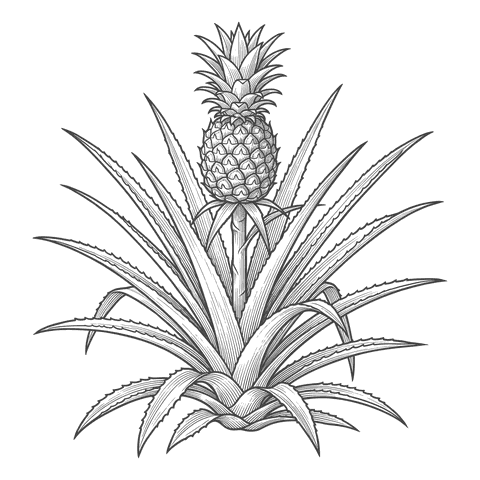
It is neither shorn nor extruded: it is extracted from the leaves. The mature leaves are scraped by hand with a potsherd or a ceramic plate to free the filaments, which are then washed, sun-dried and knotted one by one to form a continuous thread. This very slow work produces a fine, uneven yarn, still largely handmade today, which explains both the rarity and the price of the fibre.
Why it is prized
It is valued for its exceptional fineness and for a silky, almost glassy lustre, rare among plant fibres. The thread is extremely light and translucent, cool to the touch and very breathable, perfect for garments that should feel like air. It is not a fibre for bulk or stretch: its worth lies entirely in its precious look and its dry, noble hand.
Dyeing
Traditionally it is loved precisely in its natural state, a warm, lustrous ivory white that is its signature. Being cellulosic it takes the direct and reactive dyes typical of plant fibres, but the result stays softer and more delicate than on cotton, and strong shades risk dulling its natural brilliance. This is why it is often left cream-coloured or dyed in light, dusty tones.
Care
Treat it as a precious garment: very gentle hand washing in cold water, without wringing or twisting, or dry cleaning. The fibre is stiff and fragile, tends to break at folds and fray at the edges, so it cannot take rubbing, machine agitation or a tumble dryer. Dry it flat, in the shade, and store it laid out or rolled to avoid permanent creases.
End of life
It is a cellulosic plant fibre, so biodegradable and compostable when not blended with synthetics. It also comes from an agricultural by-product, the leaves of the fruit plant, and in this sense it is a material of circular reuse. Mechanical recycling is rarely done because of the rarity and fragility of the thread.
How to recognise it
| Hand | Dry, cool and smooth, with a silky slip but a stiff body: it is not soft and cuddly, it is compact and a little papery, and gives very little under finger pressure. |
|---|---|
| Look | Very lustrous, almost glassy, in a translucent ivory white. The thread is fine and deliberately uneven, with no crimp, and in the light it reveals a brilliance no other plant fibre has to the same degree. |
| Behaviour | Stiff and with little drape, it has no elastic recovery: once stretched it does not return, and at folds it marks and creases sharply. It is cool and light to wear, but fragile under rubbing and repeated flexing. |
| Burn test | Cellulosic signature: it burns quickly with a bright flame, smells of burning paper or leaves, and leaves a light, powdery grey ash, with no hard bead. |
| Home tests | Burn test: quick flame, smell of burning paper, crumbly grey ash · Wet stretch test: like plant fibres it holds without weakening, unlike wool · Fold test: it marks and keeps the crease, a sign of cellulosic stiffness |
| Confused with | Silk, for its lustre: but in the flame silk has the protein smell of burning hair, not of paper · Other leaf fibres such as abaca, coarser and duller, or rayon, softer and more yielding |
| Only in a lab | Telling piña with certainty from other cellulosic leaf fibres and measuring its fineness and composition requires laboratory microscopy and solubility tests (ISO 1833). |
Physical facts
| Property | Value | Source |
|---|---|---|
| elastic memory | None | research |
| sag | Low (very delicate) | research |
| halo | None | research |
| felting risk | None | research |
| fineness (µm) | 20–80 | research |
| moisture regain (%) | 12.0 | research |
| typical shrinkage (%) | 0–5 | estimate |
| staple length (mm) | 300–900 | research |
measured = a measurement with a reference · iso = a standard · research = a verified source · estimate = plausibility only
Good for
light and ceremonial garments · structured, translucent fabrics · precious details and inserts · blends that add lustre and coolness
Less good for
stretchy knitwear and ribbing · garments that must spring back · everyday wear and frequent washing · beginner projects