
Fibres · Plant
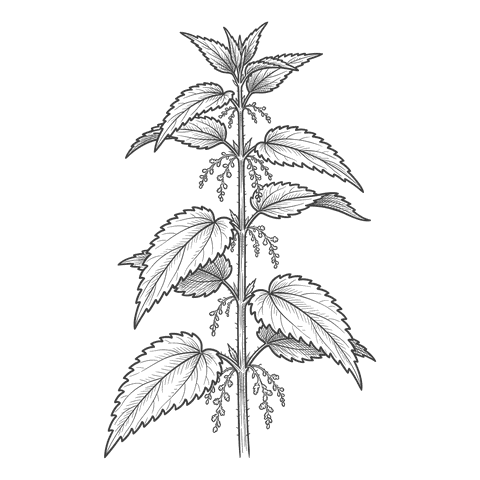
Nettle
The rustic cousin of linen: a cool, tough and surprisingly smooth plant fibre that comes from the stem of the nettle. Not very elastic but strong, it softens with every wash and gives a dry hand, ideal for summer garments.
Translated from Italian. A native knitter has not reviewed this translation yet.
History
Nettle has clothed people for millennia: traces have been found as far back as the Bronze Age, and for a long time in Northern Europe it was made into nettle cloth (Nesseltuch in German). In the First World War Germany, short of cotton, rediscovered it to make uniforms and sheeting. In the Himalayas, working giant nettle is still a living craft in the villages of Nepal. In recent years a strand of European research has revived its cultivation with selected clones, to bring it back alongside linen and hemp in sustainable knitwear.
How the yarn is made
It is a bast fibre: it lies in the bast of the stem, under the bark. The harvested stems are retted to dissolve the pectins that hold the bundles together, then scutched and hackled to free the long, lustrous fibre from the woody part. The thread that results is compact and even; subsequent degumming makes it finer and easier to spin.
Why it is prized
It combines the coolness of linen with even greater tenacity: the fibre is hollow inside, so it breathes, absorbs moisture and gives the garment a dry feel even in the heat. It grows with almost no irrigation, fertiliser or pesticides, on marginal land, which makes it one of the plant fibres with the lightest environmental footprint. In knitwear it brings structure, lustre and a lovely clean fall.
Dyeing
Like all cellulose fibres it takes direct, reactive or vat dyes, and welcomes the natural dyes of tradition (woad, madder, walnut husk). The result is less bright and saturated than on wool and tends to lighten over time; the natural tones, from ecru to greenish beige, are part of its charm.
Care
Strong and washable: it withstands frequent washing, which actually softens it and brings out its hand. It does not felt and hardly pills at all, because the fibre is smooth and has no scales. Like linen it tends to crease and show folds: iron it slightly damp and dry it flat so the knit does not distort.
End of life
A pure cellulose fibre, it is fully biodegradable and compostable at end of life, provided it is not blended with synthetics. It lends itself to mechanical recycling as staple and, being grown with very few inputs, closes a virtuous agricultural cycle from field to garment.
How to recognise it
| Hand | Cool and dry to the touch, smoother and less stiff than hemp. When new it can feel a little rough, but it softens visibly with washing. |
|---|---|
| Look | Lustrous, even surface with a silky sheen reminiscent of linen; no crimp, the yarn looks straight and clean, with no halo. |
| Behaviour | It does not recover after stretching and does not bounce back: it has no elastic memory at all. It creases easily, breathes well and keeps the garment cool. |
| Burn test | Cellulosic signature: it burns quickly with a bright flame, smells of burning paper or leaves, and leaves a light, crumbly grey ash, with no melted bead. |
| Home tests | Burn test: quick flame, smell of burning paper, crumbly ash · Wet stretch test: the wet fibre stays strong, in fact gets stronger, unlike wool · Stretch test: pull and release, it stays stretched and does not spring back |
| Confused with | Linen, almost impossible to tell apart by eye or in the flame, but nettle is often smoother and more even · Hemp and ramie, other bast fibres with the same cellulosic signature |
| Only in a lab | Telling nettle from linen, hemp or ramie with certainty requires laboratory microscopy (ISO 17751) or chemical analysis of composition (ISO 1833). |
Physical facts
| Property | Value | Source |
|---|---|---|
| elastic memory | None | research |
| sag | Low | research |
| halo | None | research |
| felting risk | None | research |
| fineness (µm) | 20–50 | research |
| moisture regain (%) | 12.0 | research |
| typical shrinkage (%) | 0–5 | estimate |
| staple length (mm) | 40–120 | research |
measured = a measurement with a reference · iso = a standard · research = a verified source · estimate = plausibility only
Good for
cool, breathable summer garments · structured knitwear with a clean fall · blends with linen and hemp · anyone looking for low-impact fibres
Less good for
stretchy knitwear · ribs and cuffs that must spring back · soft, cosy next-to-skin garments · very fluid drape