
Fibres · Animal
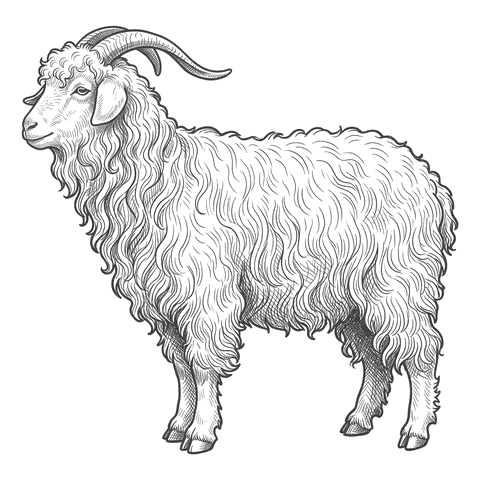
Mohair (Angora goat)
Extremely light and wrapped in a soft, airy halo that fills the garment with air. It shines like silk and is very warm, but the long hair catches and will not let go: think twice first, because a mohair knit is almost impossible to unravel.
Translated from Italian. A native knitter has not reviewed this translation yet.
History
It takes its name from the region of Angora, today's Ankara, where the goat has been raised for centuries. For its lustre it was nicknamed the "diamond fibre", and its moment of glory lives on in the memory of soft throws and fuzzy sweaters of the 1980s. Today production has largely moved to South Africa and Texas, its two main centres.
How the yarn is made
It is obtained by shearing, usually twice a year. The kid's first clip gives kid mohair, the finest, softest and most prized; with age the goat grows progressively coarser, more assertive hair. The fleece, very lustrous and in long locks, is carded or combed and often blended with wool, which lends it the elasticity mohair lacks.
Why it is prized
It combines three qualities rarely found in one fibre: a silky lustre that makes colours glow, very high cover and warmth for almost no weight, and above all the halo. That cloud of long, shiny hairs rising from the knit gives volume and dramatic depth; it is the unmistakable signature of mohair, impossible to imitate with other fibres.
Dyeing
Excellent. Like all protein fibres it binds acid dyes fast, and the lustrous surface reflects light, making shades look brighter and more saturated than on matt wool. It is one of the fibres that best renders vivid colours and jewel tones.
Care
Hand wash in cold water with a gentle detergent and dry flat. It felts far less than wool, but it sheds, especially when new: light brushing raises the halo and is part of finishing the garment. Take care when washing it with other things, because the long hairs migrate and stick to everything.
End of life
Biodegradable and compostable like other pure keratin animal fibres. Blends with wool remain mechanically recyclable, while the halo and the hair length make clean recovery of the single fibre harder than for a smooth wool.
How to recognise it
| Hand | Smooth, slippery and surprisingly warm. Kid mohair is soft and silky, while adult hair is coarser and more assertive, to the point of prickling on sensitive skin. |
|---|---|
| Look | Intense, almost silky lustre and a long, airy halo of hairs standing away from the yarn: seen against the light, that shiny cloud is the sign that leaves no doubt. |
| Behaviour | It is very warm for very little weight and fills the garment with air, but recovers its shape poorly: it has little elastic memory, the hairs tangle with each other and a finished knit is almost impossible to unravel. |
| Burn test | Protein signature: it burns slowly and self-extinguishes, smells of burning hair, and leaves a crumbly black bead, like wool. |
| Home tests | Against the light: the long, shiny halo rising from the yarn is unmistakable · Burn test: slow flame, goes out by itself, smell of burning hair, crumbly ash · Fineness test: kid is soft on the neck, adult hair prickles |
| Confused with | Wool and other animal fibres in the flame (same protein signature): what sets them apart is the shiny halo, not the flame · Brushed acrylic imitating its hair: but in the flame it melts into a hard bead and feels cold to the touch |
| Only in a lab | Telling mohair from wool with certainty and distinguishing kid grade from adult hair by measuring fineness requires laboratory microscopy (ISO 17751). |
Physical facts
| Property | Value | Source |
|---|---|---|
| elastic memory | Low | research |
| sag | Low (extremely light) | research |
| halo | Extreme | research |
| felting risk | Low | research |
| fineness (µm) | 25–45 | measured |
| moisture regain (%) | 13.0 | measured |
| typical shrinkage (%) | 0–6 | estimate |
| staple length (mm) | 100–150 | measured |
measured = a measurement with a reference · iso = a standard · research = a verified source · estimate = plausibility only
For the fabric engine
| friction coefficient (µ) | 0.3 | measured |
|---|---|---|
| density (g/cm³) | 1.31 | measured |
| Young's modulus (GPa) | 4.0 | measured |
| specific bending stiffness (dyn·cm²/tex²) | 0.28 | estimate |
Good for
fuzzy, voluminous garments · brushed knits with plenty of halo · blends that add cloud and lustre · statement throws and accessories
Less good for
garments to be linked cleanly (the halo hides the loops) · ribs and cuffs that must bounce back · very sensitive skin (adult hair prickles)