
Fibres · Man-made
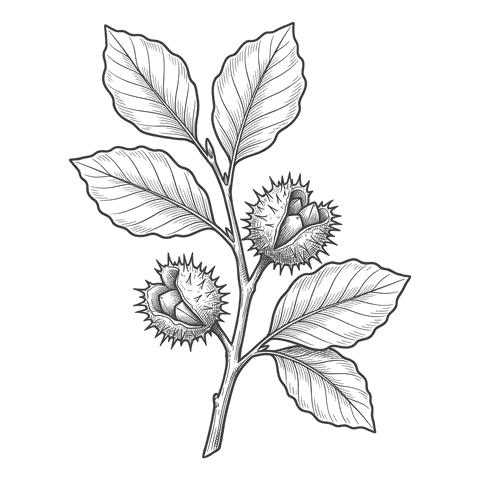
Modal (from beech)
The refined version of viscose: very soft, fluid and with a lovely understated sheen, very cool on the skin. It has little elastic memory and gives readily, so it offers a falling drape perfect for T-shirts and light garments.
Translated from Italian. A native knitter has not reviewed this translation yet.
History
It began as an evolution of viscose, the first industrial cellulose fibre of the late nineteenth century, but with an improved spinning process that increases its tenacity and stability. The modern reference is the Austrian company Lenzing, which since the 1960s has made Modal a quality brand, fed by beech wood from sustainably managed European forests. It is the regenerated cellulose that brought the hand of silk at an affordable price.
How the yarn is made
It starts from beech wood pulp, reduced to pure cellulose and dissolved in an alkaline solution. The dope is extruded through a spinneret into an acid bath that regenerates the cellulose into continuous filaments; these are then drawn, to orient the molecules and give tenacity, and finally cut into staple of the desired length, ready for spinning. It is neither a natural fibre nor a plastic: it is natural cellulose reshaped by human hands.
Why it is prized
It combines two qualities that are hard to have together: a fluid, almost silky softness and a dry coolness on the skin, because it absorbs moisture better than cotton and releases it quickly. The smooth surface gives it a delicate sheen and deep colour, while its low elastic memory makes it fall with a soft, natural drape. It is also stronger and more stable in the wash than ordinary viscose.
Dyeing
Excellent. Like all cellulose fibres it takes reactive and direct dyes very well, with full, bright shades and deep blacks thanks to the smooth surface that reflects the light. Wash fastness is good and the colour stays vivid for a long time.
Care
It does not felt and hardly pills, so it is undemanding, but when wet the cellulose fibre temporarily loses tenacity: handle it gently, wash in cold water with a neutral detergent and dry flat so it does not give under its own weight. Avoid harsh spin cycles and a hot tumble dryer.
End of life
Being pure cellulose it is biodegradable and compostable when not blended with synthetic fibres. The beech wood it comes from is usually sourced from certified, fast-regrowing forests, and the most modern processes recover much of the chemicals in a closed loop.
How to recognise it
| Hand | Very soft, smooth and fluid, cool and dry to the touch: it slides through the fingers without friction and does not hold warmth like wool. |
|---|---|
| Look | Delicate, even sheen, compact surface with no crimp or halo; the colour looks deep and the knit hangs straight and close to the body. |
| Behaviour | It drapes softly and hangs, stretches under its own weight and recovers little; it creases less than linen and cotton and keeps you only slightly warm. |
| Burn test | Cellulosic signature: it burns quickly with a bright flame, smells of burning paper or wood, does not melt, and leaves a fine, crumbly grey ash. |
| Home tests | Burn test: quick flame, smell of burning paper, crumbly ash (no melted bead) · Wet stretch test: when damp the fibre weakens and gives, so handle it with care · Sheen test: smooth surface and soft reflection, with no visible crimp |
| Confused with | Viscose: practically identical by hand and in the flame, but Modal is stronger and more stable when wet · Lyocell (Tencel): same cellulose family, they can only be told apart in a laboratory · Mercerised cotton: a similar sheen, but cotton is less fluid and drier to the touch |
| Only in a lab | Telling Modal, viscose and lyocell apart with certainty, all regenerated cellulose, requires laboratory analysis (microscopy and chemical tests to ISO 1833); by hand and in the flame they are the same. |
Physical facts
| Property | Value | Source |
|---|---|---|
| elastic memory | Low | research |
| sag | High (soft drape) | research |
| halo | None | research |
| felting risk | None | research |
| fineness (µm) | — | research |
| moisture regain (%) | 12.5 | research |
| typical shrinkage (%) | 1–5 | estimate |
| staple length (mm) | 38–40 | research |
measured = a measurement with a reference · iso = a standard · research = a verified source · estimate = plausibility only
Good for
T-shirts and light, flowing garments · fluid knitwear with a lovely drape · underwear and next-to-skin garments · blends with cotton or wool to add softness and sheen
Less good for
ribs and cuffs that must spring back · structured garments that must hold themselves up · heavy sweaters that tend to sag and stretch