
Fibres · Animal
Llama
The sturdy cousin of alpaca: warm, soft and light, with a fluid, rich drape. It has little elastic memory, so it tends to stretch: it is at its best in garments meant to hang, not in those meant to spring back.
Translated from Italian. A native knitter has not reviewed this translation yet.
History
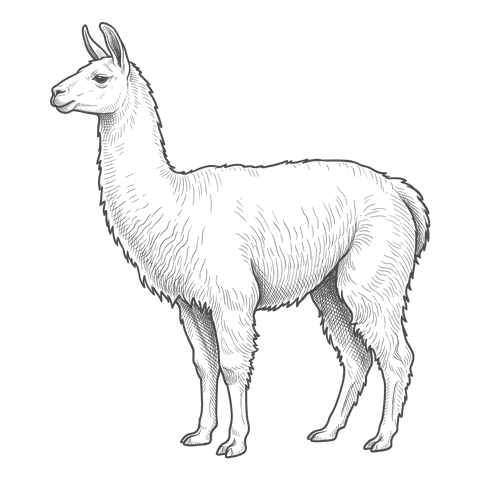
Domesticated on the Andean highlands more than four thousand years ago by pre-Inca cultures, the llama was first of all a pack animal: it carried loads along the Andean trails, while its fleece clothed herders and farmers. The heart of its production is still the altiplano between Peru and Bolivia, where the fibre moves through the same trade channels as alpaca, with which it is often processed and graded.
How the yarn is made
It is obtained by shearing, traditionally every two years. The raw fleece is double-coated: a fine, warm undercoat mixed with coarser, stiffer guard hairs (kemp). The decisive step is dehairing, the separation of the prized undercoat from the guard hairs: only the fine part, then carded or combed, gives the soft yarns suited to knitting.
Why it is prized
It is warm and very light because many of its fibres are medullated, that is hollow inside: they trap air and insulate without adding weight. Free of lanolin, it is soft on the skin and well tolerated even by those who find sheep's wool prickly. Its low crimp takes away elasticity but gives it a soft fall and a lovely drape in return.
Dyeing
The keratin takes acid dyes well, with good fastness and evenness. Historically, though, llama has mostly been worn in its own natural colours, ranging from white to beige, fawn and brown through to grey and black: an earthy palette that the Andean tradition often weaves undyed.
Care
Handle it gently: hand wash in cold water with a neutral detergent and dry flat, supporting the garment so the weight of the water does not stretch it. The risk of felting is moderate, lower than for sheep's wool, but it exists: avoid heat, rubbing and sudden changes of temperature. The fine fibre tends to pill lightly in areas of friction.
End of life
It is a natural protein fibre: biodegradable and compostable at end of life when not blended with synthetic fibres. It lends itself to mechanical recycling and, in undyed natural yarns, to upcycling into new garments and home textiles.
How to recognise it
| Hand | Soft, dry and warm, without the greasy feel of lanolin. The dehaired undercoat slides with a silky feel; in less refined yarns a few stiffer guard hairs can be felt. |
|---|---|
| Look | Discreet lustre, a little duller than alpaca, with sparse, irregular crimp. In natural yarns you can see the shaded natural colours and sometimes the lighter, shinier guard hairs. |
| Behaviour | It falls softly and drapes fluidly, but has little elastic recovery: under tension or its own weight it tends to stretch and not fully return to shape. It holds warmth very well and creases little. |
| Burn test | Protein signature: it burns slowly and self-extinguishes, smells of burning hair or horn and leaves a crumbly black bead that breaks up between the fingers. |
| Home tests | Burn test: slow flame, goes out by itself, smell of burning hair and crumbly ash · Stretch test: pull and release, llama only partly returns to shape and stays a little stretched · Lanolin test: it feels dry, without the greasy film typical of sheep's wool |
| Confused with | Alpaca, almost impossible to tell apart by hand or in the flame: llama is on average a little coarser and has more kemp · Sheep's wool, which is however more elastic, more crimped and slightly greasy with lanolin · Acrylic imitating its drape: but in the flame it melts into a hard bead and feels cold to the touch |
| Only in a lab | Telling llama from alpaca with certainty, and measuring its fineness in microns and its kemp content, requires laboratory microscopy (ISO 17751). |
Physical facts
| Property | Value | Source |
|---|---|---|
| elastic memory | Low | research |
| sag | High (similar to alpaca) | research |
| halo | Low | research |
| felting risk | Medium | research |
| fineness (µm) | 20–35 | research |
| moisture regain (%) | 13.0 | research |
| typical shrinkage (%) | 0–8 | estimate |
| staple length (mm) | 80–150 | research |
measured = a measurement with a reference · iso = a standard · research = a verified source · estimate = plausibility only
Good for
garments with fluid drape · soft shawls and stoles · warm, light knitwear · loose coats and jackets
Less good for
ribs and cuffs that must grip · fitted garments that must spring back · very stretchy knitwear