
Fibres · Plant
Kapok
One of the lightest fibres there is: hollow, barely there and full of air, slippery like silk but very short and fragile. On its own it can hardly be spun, so it is blended in to add volume and warmth without adding weight.
Translated from Italian. A native knitter has not reviewed this translation yet.
History
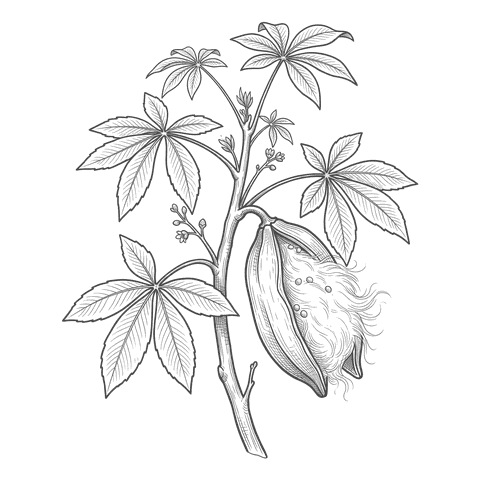
It is gathered from the fruit of Ceiba pentandra, the large tropical tree also called kapok or silk-cotton tree, found from Java to West Africa and on to Central America. Throughout the twentieth century it was the stuffing of choice for cushions, mattresses and above all life jackets and buoys: its buoyancy made it a strategic material before synthetic foams arrived. Today it is returning in blended yarns as a light, natural alternative to synthetic fillings.
How the yarn is made
It is neither shorn nor sown like cotton: the ripe pods split open and release a floss that surrounds the seeds, which is gathered by hand and separated from them. The fibre is already ready, hollow and coated with a natural wax, but it is too short, smooth and crimp-free to hold up in a pure spin: it is carded and blended with longer fibres, which give the structure while the kapok brings volume and lightness.
Why it is prized
Its secret is the hollow core: each fibre is a tiny tube full of air, which makes it extremely light, insulating and able to fill out the knit without weighing it down. In a blend, a small share of kapok is enough for a warm, soft, airy garment, with a cool, silky hand that more common fibres lack.
Dyeing
This is its weak point. The wax coating makes the fibre water-repellent and resistant to water-based dyes, so the result is duller and less even than cotton. In practice the carrier fibre of the blend is dyed, or the warm natural tone kapok carries, somewhere between beige and honey, is accepted.
Care
Handle it gently, as it is fragile and tends to flatten: hand wash in cold water, without wringing or spinning hard, and dry flat. The natural wax protects it from moisture but wears away with harsh washing, reducing its softness over time. Fewer washes and good airing are best.
End of life
It is a cellulosic plant fibre, so biodegradable and compostable at end of life, all the more since it is usually not treated with heavy finishes. Mechanical recycling is rarely done because of the very short staple and fragile fibre: the natural route is composting or reuse as loose stuffing.
How to recognise it
| Hand | Surprisingly light, almost absent to the touch, smooth and cool like silk. It is not warm on contact like wool: the feeling is airy and slippery. |
|---|---|
| Look | Lustrous and silky, in a warm natural colour between beige and honey, with no crimp: the fibres are straight, bright and very fine. |
| Behaviour | It has no elastic memory and does not recover its shape: it compresses and flattens easily. It insulates a great deal for its weight and, thanks to the wax, floats and sheds water instead of absorbing it. |
| Burn test | Cellulosic signature: it catches quickly with a bright flame, smells of burning paper or wood, and leaves a light grey ash, with no melted bead. |
| Home tests | Burn test: quick flame, smell of burning paper, crumbly ash · Weight test: a full tuft weighs almost nothing in the hand · Water test: the fibre floats and stays dry on the surface |
| Confused with | Cotton, also cellulosic in the flame, but cotton is heavier, duller and absorbs water at once · Vegetable silk and other lustrous stuffing fibres, but kapok is hollow and floats |
| Only in a lab | Confirming kapok and telling it apart from cotton or other cellulosics requires laboratory microscopy, which shows its hollow cross-section and very thin wall. |
Physical facts
| Property | Value | Source |
|---|---|---|
| elastic memory | None | research |
| sag | High (no elastic recovery) | research |
| halo | Low | research |
| felting risk | None | research |
| fineness (µm) | 10–30 | research |
| moisture regain (%) | 10.0 | research |
| typical shrinkage (%) | — | estimate |
| staple length (mm) | 8–30 | research |
measured = a measurement with a reference · iso = a standard · research = a verified source · estimate = plausibility only
Good for
light, bulky blends · warm but weightless garments · soft fillings · fancy yarns with a cool hand
Less good for
pure, hard-wearing yarns · elastic ribs and cuffs · garments under heavy wear or washed often · deep, even shades