
Fibres · Plant
Jute
The rustic, raw fibre of sacking and bags: cheap, strong and full of body, but rough on the skin. It is made for objects that have to stand up on their own, not for garments worn against the body.
Translated from Italian. A native knitter has not reviewed this translation yet.
History
It is the fibre of the Ganges delta, between Bangladesh and Indian Bengal, where the hot, humid climate and the annual floods give the plant ideal conditions. In the nineteenth century mechanical processing took hold in Dundee, Scotland, which became the world capital of the jute sack; today the supply chain has returned almost entirely to the Indian subcontinent, where Calcutta remains the main reference market.
How the yarn is made
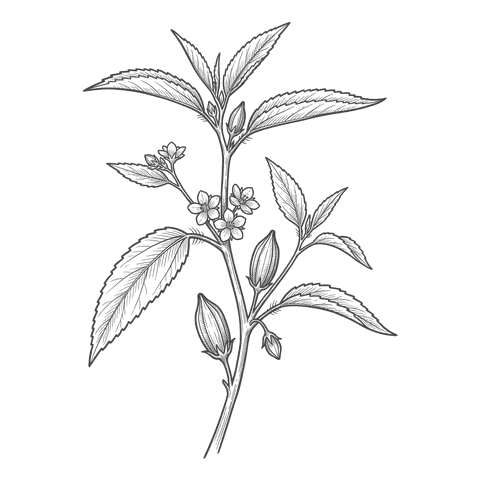
It is not obtained from a fleece but from the stem of the plant: it is a bast fibre, that is taken from the inner bark. The stems are left to soak in water (retting), which dissolves the pectins and frees the fibre bundles; these are then stripped, washed, dried and finally combed and spun. The result is a long, lustrous, wiry yarn, closer to string than to a soft ball of yarn.
Why it is prized
Its merit is not softness but substance. It is one of the cheapest natural fibres with the highest yield per hectare, it grows fast without heavy chemical inputs and gives a yarn that holds its shape and does not go limp. For baskets, structured bags, sacks and home furnishings it is exactly what is needed: body, hold and a raw surface with a strong character.
Dyeing
Cellulose takes direct and reactive dyes well, but the natural colour of the fibre is a warm golden beige that tends to dull the shades: earthy, natural tones work best, while light, bright colours require bleaching first. Jute also tends to yellow with light over time.
Care
It dislikes water and prolonged damp: when wet it loses body and can develop mould and odour, so clean it dry or with a barely damp cloth, never by immersion. Keep it in a dry, ventilated place, away from direct sun, which yellows it and makes it brittle. At first it sheds a little fluff and some bits of chaff, which decrease with use.
End of life
It is pure, natural cellulose: fully biodegradable and compostable when not coated or bonded to plastics. At end of life it returns to the soil within a few months, and it is often recommended precisely as a natural alternative to synthetic sacks.
How to recognise it
| Hand | Rough, dry and stiff, decidedly rough on the skin. To the touch it recalls a rope or raw canvas more than a soft fabric, and it is cool, never warm. |
|---|---|
| Look | Warm golden-beige colour with a silky lustre that is surprising for such a rustic fibre. The surface is irregular, with slubs and variations in thickness that reveal its raw plant origin. |
| Behaviour | No elastic recovery: pulled, it stays pulled, and when folded it tends to mark and crease. It bears weight and keeps its structure, but it does not drape and does not spring back. |
| Burn test | Cellulosic signature: it burns quickly with a bright yellow flame, smells of burning paper or wood, and leaves a light, crumbly grey ash, with no hard bead. |
| Home tests | Burn test: quick flame, smell of burning paper, crumbly ash · Elasticity test: pull and release, jute does not spring back · Wet stretch test: like other plant fibres it weakens when damp |
| Confused with | Hemp and raw linen: similar bast fibres, but lighter in colour, finer and more water-resistant · Sisal and coir: other cordage fibres, but stiffer and woodier to the touch |
| Only in a lab | Telling jute apart with certainty from other bast fibres (hemp, linen, kenaf) and measuring its fineness requires laboratory microscopy (ISO 17751) or chemical analysis (ISO 1833). |
Physical facts
| Property | Value | Source |
|---|---|---|
| elastic memory | None | research |
| sag | Low | research |
| halo | None | research |
| felting risk | None | research |
| fineness (µm) | 40–90 | research |
| moisture regain (%) | 13.7 | research |
| typical shrinkage (%) | 0–8 | estimate |
| staple length (mm) | 1500–3000 | research |
measured = a measurement with a reference · iso = a standard · research = a verified source · estimate = plausibility only
Good for
structured bags and sacks · baskets and containers · home furnishings · objects that must stand on their own
Less good for
next-to-skin garments · stretchy knitwear · soft drape · objects exposed to water