
Fibres · Plant
Hemp
Very strong and cool, it starts out stiff and almost woody but softens with every wash. It is the toughest plant fibre: perfect for structured garments and accessories that have to last, less so for softness against the skin when first worn.
Translated from Italian. A native knitter has not reviewed this translation yet.
History
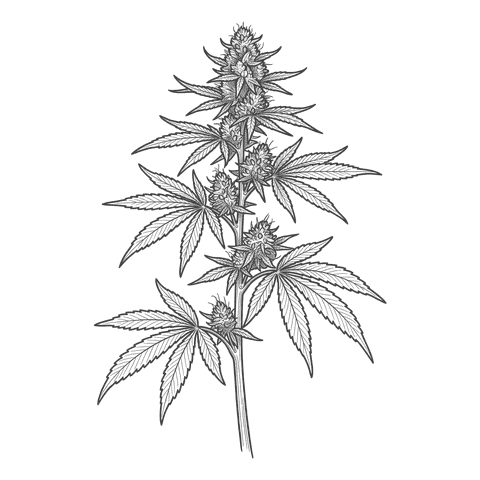
An ancient fibre, for millennia the backbone of sails, ropes, nets and sturdy cloth: without hemp there would have been no seafaring. Italy was among the world's largest producers until the twentieth century, with hemp from Carmagnola and the Bologna area considered among the finest in the world. After a long eclipse in the twentieth century, it is now enjoying a revival as a sustainable fibre for fashion and knitwear.
How the yarn is made
It is extracted from the stem by retting and scutching, like linen: the woody part is broken and separated from the long bast fibres. For fine knitwear the fibre is often cottonised, that is shortened and refined until it behaves like cotton, so that it can be spun fine and even.
Why it is prized
It combines exceptional strength with a very low environmental impact: it grows fast with little water, without pesticides, and improves the soil. It is cool and very breathable, with a natural antibacterial and anti-odour action, and it has the rare quality of improving with age, softening without losing body.
Dyeing
Being cellulose, it dyes well with reactive and direct dyes, like cotton and linen. The result tends to be matt and a little more subdued than on a lustrous fibre, with a fine depth in natural and earthy tones; historically it was also used undyed or simply bleached.
Care
Very durable and washable without worry: indeed, it is one of the rare yarns that improves wash after wash, losing stiffness and gaining softness. It does not felt and hardly pills. Like all cellulosics it creases easily, and it is best dried flat or ironed while still damp.
End of life
Fully biodegradable and compostable at end of life, among the lowest-impact fibres of all. In blends with cotton it remains easy to recycle mechanically, while on its own it breaks down without leaving residues.
How to recognise it
| Hand | Rustic and cool, rougher than linen and rather stiff when new; to the touch it stays dry and never slippery, and it softens noticeably with wear and washing. |
|---|---|
| Look | Matt, with little lustre, a coarse and slightly irregular fibre that shows small variations in thickness along the yarn. |
| Behaviour | Very strong and almost inelastic: it does not recover after stretching and has no halo, but it is very cool, very breathable and naturally antibacterial. Like linen it creases visibly. |
| Burn test | Cellulosic signature: it burns quickly with an open flame, smells of burning paper or leaves, and leaves a light grey ash, with no melted bead. |
| Home tests | Burn test: quick flame, smell of burning paper, crumbly grey ash · Wet test: like linen it stays strong or gets stronger when damp, unlike wool · Stiffness test: when new it is stiffer and rougher than linen, with an almost papery handle |
| Confused with | Linen: almost identical, but hemp is usually rougher, stiffer and even stronger · Cotton, when cottonised: but it stays cooler, tougher and less soft |
| Only in a lab | Telling hemp from linen with certainty is notoriously difficult even in the laboratory, and requires microscopy and targeted chemical tests (ISO 1833). |
Physical facts
| Property | Value | Source |
|---|---|---|
| elastic memory | None (extremely stiff) | research |
| sag | Low (softens with wear) | research |
| halo | None | research |
| felting risk | None | research |
| fineness (µm) | — | research |
| moisture regain (%) | 12.0 | research |
| typical shrinkage (%) | 3–10 | estimate |
| staple length (mm) | 150–900 | research |
measured = a measurement with a reference · iso = a standard · research = a verified source · estimate = plausibility only
Good for
sturdy, structured summer garments · bags and accessories · hemp-cotton and hemp-linen blends · cloth and garments that must last
Less good for
stretchy knitwear with ribs that spring back · very soft next-to-skin garments when first worn · very fluid drape