
Fibres · Man-made
Cupro / Bemberg (cotton linter)
Vegetable silk: a regenerated cellulose filament made from cotton residues, silky, cool and smooth-running. It has no elasticity at all and is at its best in fluid drape, where it falls with a soft weight that elastic fibres lack.
Translated from Italian. A native knitter has not reviewed this translation yet.
History
It was born at the end of the nineteenth century in Germany, when the J.P. Bemberg mill in Wuppertal perfected the cuprammonium process and gave it the trade name that is still the best known today, Bemberg. It is the most refined of the historic regenerated celluloses and, since the European plants closed, it is now made almost exclusively in Japan, where it remains a fine niche yarn for linings and garments with a sought-after drape.
How the yarn is made
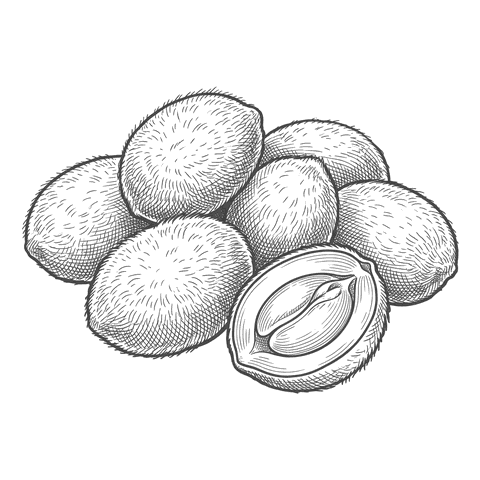
The starting point is linter, the very short fuzz left on cotton seeds after ginning, too short to be spun as cotton. This almost pure cellulose is dissolved in a solution of copper and ammonia, then regenerated in a bath that precipitates it as it is extruded through spinnerets into a very fine continuous filament. It is a filament, not a staple: that is why its handle recalls silk more than the cotton it comes from.
Why it is prized
It combines the coolness and breathability of cellulose with the silky smoothness of continuous filament. It absorbs moisture well and stays cool on the skin, slides without friction and is antistatic, qualities that have always made it the noble lining par excellence and, in knitwear, a fibre that gives drape and a soft lustre to those looking for fluidity more than structure.
Dyeing
Excellent. Being pure cellulose, it binds direct and reactive dyes with good brilliance and evenness, with a deep, saturated result helped by the smooth surface of the filament. Colours come out lively and the silky sheen enhances their depth.
Care
A delicate fibre: when wet it loses strength and tends to crumple and shrink, so many garments are dry-cleaned. At home, wash it by hand in cold water with a neutral detergent, without twisting or wringing, and dry it flat away from heat. It creases easily and, since its give is high, it should be stored flat and never hung, so it does not stretch under its own weight.
End of life
It is cellulose and, under suitable conditions, biodegrades like other plant-based fibres. It also comes from an agricultural by-product, linter, which would otherwise be under-used: a head start in terms of resources, set against a chemical process that requires the solvents to be recovered in a closed loop.
How to recognise it
| Hand | Silky, smooth and slippery, cool and almost cold to the touch like a cellulose, but with a silky slipperiness that sets it apart from cotton. |
|---|---|
| Look | Soft, deep lustre, never glassy, and a fluid drape that falls with weight. No halo: the surface is clean and compact. |
| Behaviour | It drapes heavily and flows, gives under its own weight by lengthening and does not recover after stretching. It creases, does not hold much warmth and stays cool on the body. |
| Burn test | Cellulosic signature: it catches fire quickly like paper, burns with a lively, steady flame, smells of burning paper or wood, and leaves a light, crumbly grey ash, with no melted bead. |
| Home tests | Burn test: quick, paper-like flame, smell of burning paper, crumbly ash · Wet stretch test: the cellulose weakens and gives when wet · Touch: smooth, cool and slippery, without the warmth and elasticity of wool |
| Confused with | Viscose and modal: other regenerated celluloses, almost identical by hand and in the flame · Real silk: similar handle, but in the flame it has a protein signature (smell of hair, crumbly bead) · Acetate: it looks silky but in the flame it melts and drips, which cupro does not |
| Only in a lab | Separating cupro with certainty from its cellulosic cousins (viscose, modal, lyocell) requires the laboratory: selective solubility (ISO 1833) and microscopy of the cross-section, which in cupro is roundish and smooth. |
Physical facts
| Property | Value | Source |
|---|---|---|
| elastic memory | None | research |
| sag | High (similar to silk) | research |
| halo | None | research |
| felting risk | None | research |
| fineness (µm) | — | research |
| moisture regain (%) | 11.0 | research |
| typical shrinkage (%) | 3–8 | estimate |
| staple length (mm) | — | research |
measured = a measurement with a reference · iso = a standard · research = a verified source · estimate = plausibility only
Good for
fluid, cool drape · soft tops and blouses · linings and unlined garments · cool summer garments · blends that add smoothness and lustre
Less good for
stretchy ribs and cuffs · garments that must spring back · structured knitwear and raised textures · stitches that need body and memory