
Fibres · Plant
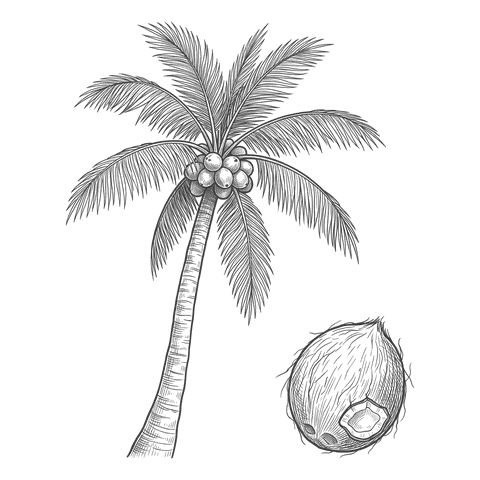
Coir (coconut)
The stiffest, roughest fibre in the plant kingdom, taken from the husk of the coconut. It was not born to clothe but to endure: it is pure structure, made for doormats, ropes, rugs and baskets that have to last.
Translated from Italian. A native knitter has not reviewed this translation yet.
History
Coir has accompanied seafaring and coastal crafts around the Indian Ocean for centuries: coir ropes held together the sewn boats of the Arabian and Indian coasts long before hemp hawsers. Industrial processing began in Kerala, India, which together with Sri Lanka is still the world centre of the fibre, from hand-spun yarn to the looms weaving mats for export.
How the yarn is made
It is extracted from the mesocarp, the fibrous layer between the outer skin and the woody shell of the nut. The husks are soaked in water (traditional retting lasts months in brackish lagoons) to break down the soft parts, then beaten and combed to free the fibres. White coir comes from unripe nuts and is lighter and more pliable; brown coir comes from ripe nuts and is thicker, stiffer and stronger.
Why it is prized
Its merit is entirely structural, not textile. It is one of the natural fibres richest in lignin, the same substance that stiffens wood: this makes it extremely stiff, rot-proof and remarkably resistant to salt water and abrasion. For knitwear it has neither elastic memory nor softness, but where hold, roughness and durability in damp conditions are needed it is unbeatable.
Dyeing
Difficult and not very bright. The high lignin content and the ground colour, from straw to dark brown, dull the shades: it is almost always worked natural or with dark, covering dyes. Historically brown coir won out precisely because its warm colour needed no dyeing.
Care
It dislikes standing fresh water, which in the long run encourages mould, while it tolerates brackish damp and outdoor use very well. Clean it dry, by shaking and brushing; do not machine-wash it and do not twist it. With use it loses a few rough fibres at the surface, but it does not form soft fuzz like knitting fibres.
End of life
Fully biodegradable and compostable: being almost entirely cellulose and lignin, it returns to the soil without residue. It is widely reused in gardening and nurseries, where it becomes growing medium, mulch and anti-erosion netting for stabilising slopes and embankments.
How to recognise it
| Hand | Rough, dry and prickly, cold and woody to the touch. It is so stiff that it will not bend between the fingers like a yarn: it behaves more like a bristle or a twig. |
|---|---|
| Look | Matt and uneven, from straw to reddish brown, with thick, curly, irregular fibres clearly visible to the naked eye. No lustre, no halo. |
| Behaviour | It has no elastic recovery: bent, it stays bent. It does not crease in the way soft textiles do, because it is too stiff to form folds, and it holds its shape through sheer hardness, not memory. |
| Burn test | Cellulosic, woody signature: it burns with a lively, steady flame, smells of burning paper and wood, and leaves a light, crumbly grey ash without melting or balling up. |
| Home tests | Stiffness test: the fibre does not knot easily, it tends to snap rather than bend · Burn test: steady flame, smell of burning wood, crumbly grey ash · Salt water test: it withstands prolonged immersion without weakening or rotting |
| Confused with | Palm fibre or raw raffia: similar to the eye, but more flexible and less woody when bent · Sisal and other hard cordage fibres: smoother and more regular, while coir stays coarse and untidy |
| Only in a lab | Confirming the species and telling it apart from other hard fibres (sisal, jute, abaca) requires laboratory microscopy and analysis of the lignin content (ISO 17751). |
Physical facts
| Property | Value | Source |
|---|---|---|
| elastic memory | None | research |
| sag | None (very stiff) | research |
| halo | None | research |
| felting risk | None | research |
| fineness (µm) | 100–450 | research |
| moisture regain (%) | 10.5 | research |
| typical shrinkage (%) | — | research |
| staple length (mm) | 150–350 | research |
measured = a measurement with a reference · iso = a standard · research = a verified source · estimate = plausibility only
Good for
doormats and mats · ropes and cordage · hard-wearing rugs · rigid baskets and containers · garden substrates and netting
Less good for
garments to wear · stretchy knitwear · any contact with the skin · drape and softness