
Fibres · Animal
Cashmere
Soft luxury by definition: warm, light and enveloping, with a creamy handle out of proportion to its weight. It is a comfort garment to treat with respect, because it is as delicate as it is precious.
Translated from Italian. A native knitter has not reviewed this translation yet.
History
It began as the Kashmir shawl, the famous paisley that became a status symbol throughout Europe in the nineteenth century. Its modern history, however, is above all Italian: Loro Piana, Brunello Cucinelli in Solomeo and the Biella district made it synonymous with textile luxury, turning the raw down of the goats into top-of-the-range yarns recognised worldwide.
How the yarn is made
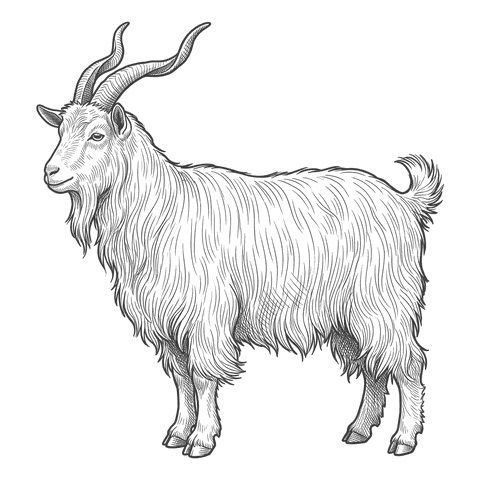
It is not shorn, it is combed. During the spring moult the goat's undercoat (the down) is gathered, then an industrial dehairing process separates the fine fibre from the coarse, bristly guard hair. The yield is very low, a few hundred grams of good fibre per goat each year: it is this scarcity, even more than the fineness, that explains its price.
Why it is prized
It offers an unmatched warmth-to-lightness ratio: it is very warm while weighing very little, and has an unmistakable softness to the touch. Value it for what it does well, which is to wrap and comfort in light layers, not for resisting wear: it is a fine, fragile fibre, at its best in garments lived in gently and, ideally, from a traceable supply chain.
Dyeing
Excellent, as with all protein fibres: keratin fixes acid dyes with good yield and evenness, giving full, deep colours. The dyebath must be kept gentle, however, at a controlled temperature, so as not to stress the fibre or start it felting.
Care
A fibre to handle with care: hand wash or wool cycle in cold water, gentle detergent, and dry flat so it does not lose its shape. It has less crimp than merino, so the fabric tends to grow and to pill more easily. Early pilling comes from the short fibres at the surface and is not in itself a sign of poor quality: it lessens as the pills are gently removed.
End of life
Biodegradable and compostable. It can be mechanically recycled and upcycled, but each cycle shortens the fibre length: the regenerated cashmere that results has more halo and less strength than the original, while remaining a valuable resource for reducing waste of such a rare material.
How to recognise it
| Hand | Creamy softness and surprising warmth for its weight: very light and very warm. A telling detail is that real cashmere is never cold to the touch, unlike acrylic or viscose fakes. |
|---|---|
| Look | Matt and very fine, with a light, discreet halo. It has little lustre and a soft surface, without the marked, visible crimp typical of merino. |
| Behaviour | It is very warm and light, but not very elastic: the fabric tends to grow under its own weight rather than recover, and it pills more easily because of the fibre's low crimp. |
| Burn test | Protein signature: in the flame it burns slowly, self-extinguishes and leaves a crumbly ash with a smell of burning hair. Be careful, though: in the flame it cannot be told apart from wool or silk. |
| Home tests | Warmth and lightness test: very warm while weighing very little · Be wary of a price that is too low: it often points to a blend or a fake · Burn test to rule out synthetics: it burns and crumbles, it does not melt into a bead |
| Confused with | Extrafine merino and cashmere-wool blends, very similar by hand · Acrylic or viscose fakes, but they stay cold to the touch and in the flame they melt instead of crumbling |
| Only in a lab | Only the laboratory is conclusive: ISO 17751 electron microscopy measures the diameter and distinguishes cashmere from yak and other wools, and the CCMI threshold of a mean diameter of 19 microns or less can only be verified in the laboratory. |
Physical facts
| Property | Value | Source |
|---|---|---|
| elastic memory | Medium | research |
| sag | Medium | research |
| halo | High | research |
| felting risk | Medium | research |
| fineness (µm) | 14–19 | research |
| moisture regain (%) | 15.0 | research |
| typical shrinkage (%) | 0–8 | estimate |
| staple length (mm) | 34–40 | research |
measured = a measurement with a reference · iso = a standard · research = a verified source · estimate = plausibility only
For the fabric engine
| friction coefficient (µ) | 0.22 | measured |
|---|---|---|
| density (g/cm³) | 1.3 | measured |
| Young's modulus (GPa) | 2.2 | measured |
| specific bending stiffness (dyn·cm²/tex²) | 0.18 | estimate |
Good for
light, warm layers · crew necks and soft next-to-skin sweaters · high-end comfort garments · light accessories such as scarves and stoles
Less good for
cuffs, elbows and high-abrasion areas · garments for heavy daily wear · knitwear that must spring back like merino