
Fibres · Animal
Camel
The luxurious warmth of the steppes: a very fine, very light undercoat in a warm natural caramel colour. It is far warmer than its weight suggests, but it is prone to felting, so it needs gentle handling.
Translated from Italian. A native knitter has not reviewed this translation yet.
History
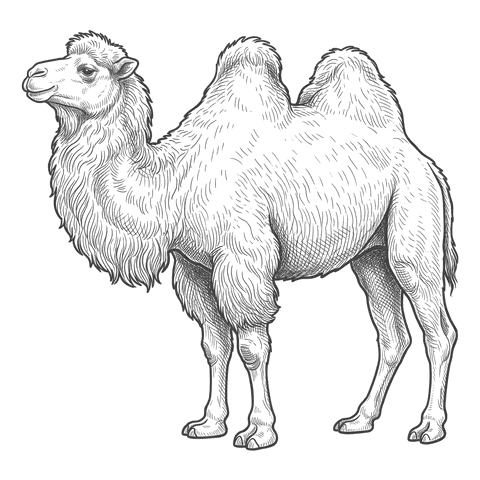
It is the fibre of the Bactrian camel, which lives through the bitter winters of the plateau between Mongolia and China. To protect itself from the cold it grows a double coat: the outer hair, coarse and water-repellent, and the soft undercoat (the down), which is the precious part. Carried to the West along the caravan routes, it arrived with a reputation as the wool of travellers and nomads, and the breeding regions are still Mongolia and Inner Mongolia today.
How the yarn is made
It is not shorn: in spring the camel moults naturally, and the undercoat is gathered by hand or combed out during the moult. Then comes a patient sorting to separate the fine down from the coarse guard hair; only the finest, lightest fraction becomes fine knitting yarn. Hence its rarity and high cost.
Why it is prized
It offers one of the best warmth-to-weight ratios of all: it insulates like few other fibres while staying very light and airy, because the down is hollow and traps a lot of air. The handle is soft, dry and velvety, and the warm natural caramel colour needs no dye to look elegant.
Dyeing
It is the hardest fibre to dye in light shades, because its natural brown pigment covers delicate tones. Traditionally it is worked undyed, in tones from beige through camel to dark brown; when it is dyed, dark, warm colours that sit well with the amber ground are chosen, using acid dyes as for other protein fibres.
Care
It asks for a light hand. Wash it by hand in cold water with a gentle detergent, without rubbing or wringing, and dry it flat away from heat. Like all fine animal fibres it blooms a little, but the real risk is felting: heat, moisture and agitation together make it felt quickly and irreversibly.
End of life
A natural protein fibre, it is biodegradable and compostable at end of life when not blended with synthetics. It lends itself to mechanical recycling along with other fine fibres, and given its value it is worth repairing and darning garments before discarding them.
How to recognise it
| Hand | Soft, dry and velvety, warm to the touch and surprisingly light; warmer and less slippery than cashmere, with a slightly fuller touch. |
|---|---|
| Look | Warm, natural caramel colour, matt, with little lustre and a slight soft halo on the surface; the crimp is less marked than in wool. |
| Behaviour | It insulates very well and weighs very little, drapes softly but without great fluidity, recovers moderately and tends to bloom a little with wear. |
| Burn test | Protein signature like wool: it burns slowly, self-extinguishes, smells of burning hair or horn, and leaves a crumbly black bead. |
| Home tests | Burn test: slow flame, goes out on its own, crumbly ash and smell of burning hair · Wet stretch test: a protein fibre weakens when damp, plant fibres do not · Natural colour: an even, warm caramel is a clue, but not proof |
| Confused with | Cashmere, very similar by hand: camel is slightly warmer and typically warmer in tone · Fine wool dyed camel colour: in the flame they are indistinguishable, something else is needed to separate them · Alpaca, another warm, matt animal fibre in natural tones |
| Only in a lab | Telling camel apart with certainty from cashmere and other fine fibres, and measuring its fineness in microns, requires laboratory microscopy (ISO 17751). |
Physical facts
| Property | Value | Source |
|---|---|---|
| elastic memory | Medium | research |
| sag | Medium | research |
| halo | Medium | research |
| felting risk | High | research |
| fineness (µm) | 16–22 | research |
| moisture regain (%) | 14.0 | research |
| typical shrinkage (%) | 0–10 | estimate |
| staple length (mm) | 25–40 | research |
measured = a measurement with a reference · iso = a standard · research = a verified source · estimate = plausibility only
Good for
warm, light knitwear · soft outerwear · shawls and stoles · natural shades without dyeing · next-to-skin garments, for softness
Less good for
light, bright colours (the natural pigment dulls them) · garments washed often or by machine · ribs that must keep their spring for long · heavy abrasion