
Fibres · Plant
Banana fibre
A lustrous plant fibre close to silk, with a fine sheen and a cool handle. It has very little elasticity: it brings lustre and lightness to fluid summer garments rather than to ribs and cuffs that must spring back.
Translated from Italian. A native knitter has not reviewed this translation yet.
History
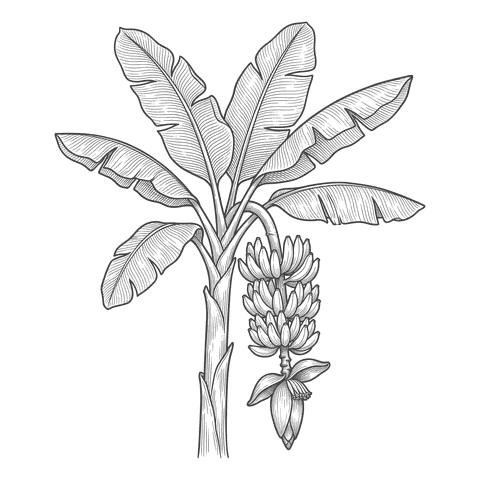
The banana has been grown for millennia in South and Southeast Asia, where the fibres of the stem have been spun and woven since ancient times: in Japan they have been made for centuries into the kijoka bashofu cloth of Okinawa, while in the Philippines its fibrous cousin gives abaca, historically known as "Manila hemp" for cordage and sails. Today banana fibre is coming back into fashion as a recovered material, because it comes from the pseudostem the plant discards after the fruit is harvested.
How the yarn is made
It is extracted from the sheaths of the pseudostem, the part that would otherwise remain as agricultural waste. The sheaths are decorticated and the fibre bundles separated, washed and dried: the outer ones are coarser and more rustic, suited to cordage and structured fabrics, the inner ones are fine and silky, suited to light knitwear. The fibre is then combed and spun, often blended with cotton or silk to soften its handle and give it more cohesion.
Why it is prized
It combines silky lustre and lightness with a recovered origin: it comes from an agricultural by-product and needs no new cultivation. It gives garments a lively sheen, a cool, dry handle and very good moisture absorption, ideal for summer. It is strong in tension and gives yarns a fluid drape that wool cannot.
Dyeing
Good, like all cellulosic fibres: it takes direct and reactive dyes, which bind to cellulose firmly and evenly. Its natural lustre enhances colours, making them bright and deep, while the undyed tone tends to a warm ivory that some prefer to leave as it is.
Care
Treat it gently: hand wash or delicate cycle, cold water and neutral detergent, without wringing, so as not to break the fibres while they are wet. Like all cellulosics it creases, so dry it flat and iron it at medium temperature, ideally with a damp cloth. It does not felt and forms almost no fuzz on the surface.
End of life
It is pure cellulose, and therefore biodegradable and compostable at end of life when not blended with synthetic fibres. Since it is already an agricultural by-product of the banana harvest, using it is in itself a form of upcycling; it can be mechanically recycled together with other plant fibres.
How to recognise it
| Hand | Cool, dry and smooth to the touch, with a slipperiness close to that of silk. It is not warm like wool and has no springiness at all. |
|---|---|
| Look | Lustrous, with a marked silky sheen and no halo or fuzz. The yarn looks compact and even, ivory-gold in its undyed state. |
| Behaviour | It drapes with a fluid, heavy fall, recovers poorly after stretching and tends to crease like linen and cotton; it holds little warmth. |
| Burn test | Cellulosic signature: it burns quickly with a lively flame, smells of burning paper or leaves, and leaves a light, crumbly grey ash, with no hard beads. |
| Home tests | Burn test: quick flame, smell of burning paper, crumbly ash · Wet stretch test: when wet it holds under tension, unlike wool · Elasticity test: pull and release, it stays lengthened and does not bounce back |
| Confused with | Silk: similar handle and lustre, but silk in the flame smells of burning hair and leaves a crumbly bead · Linen and other lustrous plant fibres (ramie): same cellulosic burn signature, hard to tell apart by hand · Viscose and other lustrous regenerated cellulosics, which imitate the same sheen |
| Only in a lab | Telling banana fibre apart with certainty from other natural cellulosics (linen, ramie, hemp) and recognising its structure requires laboratory microscopy (ISO 20706) and composition tests (ISO 1833). |
Physical facts
| Property | Value | Source |
|---|---|---|
| elastic memory | None | research |
| sag | Medium (similar to silk) | research |
| halo | None | research |
| felting risk | None | research |
| fineness (µm) | 12–30 | research |
| moisture regain (%) | 13.0 | research |
| typical shrinkage (%) | 0–8 | estimate |
| staple length (mm) | — | research |
measured = a measurement with a reference · iso = a standard · research = a verified source · estimate = plausibility only
Good for
fluid, light summer garments · tops and shawls with good drape · lustrous details and silky sheen · blends with cotton or silk
Less good for
stretchy knitwear · ribs and cuffs that must spring back · garments needing warmth and elastic memory