
Fibres · Animal
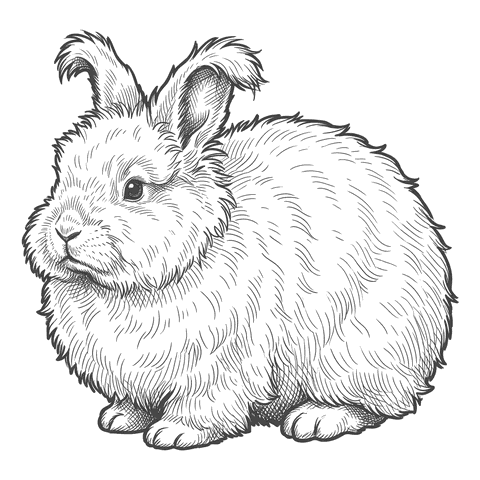
Angora (rabbit)
The hollow hair of the Angora rabbit: incredibly soft, very warm and light, with a cloud-like halo no other fibre can give. In return it sheds and felts extremely easily, so it is at its best in blends rather than on its own.
Translated from Italian. A native knitter has not reviewed this translation yet.
History
It takes its name from Ankara (the ancient Angora), which also gives us mohair from the goat: a shared name that still causes confusion today, but here we mean the rabbit, not the goat. Kept in Europe since the eighteenth century as a luxury animal, it is now produced mainly in China, while France preserves a tradition of fine breeding. Animal welfare is a sensitive issue for this fibre: in sound supply chains the hair is gathered by periodic combing or shearing, never by plucking, and that is the criterion that marks out a truly ethical garment.
How the yarn is made
The hair is obtained by combing or shearing the rabbit every few months, when the moult allows. Because the staple is smooth, slippery and without crimp, it is almost always spun in a blend with wool or nylon, which give it cohesion and hold: on its own it would tend to slip apart and shed. The hollow cross-section of the fibre is what makes it so light and warm for its volume.
Why it is prized
For warmth relative to weight it has no rival: the hollow core of the hair traps air and insulates like down, while staying extremely light. Add to this a silky softness and above all the halo, that airy cloud that wraps the garment and softens every outline. Small percentages in a blend, usually between ten and thirty per cent, are enough to give a yarn aura, warmth and a precious handle.
Dyeing
Excellent, as with all protein fibres: keratin fixes acid dyes well, with full, fast shades. The halo treats colour in a particular way, diffusing it into a soft haze that blurs outlines and gives garments the misty, luminous effect typical of angora.
Care
A very delicate fibre. Wash it by hand in cold water with a neutral detergent, without rubbing or wringing, and dry it flat: heat, moisture and friction make it felt in an instant, and its felting risk is the highest of all animal fibres. Shedding is greatest when new and decreases with wear; a short spell of the garment in the freezer helps to keep it down. Best stored folded and aired, away from damp.
End of life
As a pure keratin protein it is fully biodegradable and compostable at end of life. Mechanical recycling, on the other hand, is difficult: the hair is too short and slippery to be regenerated into new yarn, and in blended garments it stays bound to the other materials.
How to recognise it
| Hand | Extremely soft, airy and surprisingly warm, with a lightness that seems out of proportion to its volume: you feel more air than fibre between your fingers. |
|---|---|
| Look | Very long, fluffy halo that blurs the outlines of the garment, with a slight silky lustre. It is the cloud fibre: the fabric seems surrounded by a soft haze, with no trace of marked crimp. |
| Behaviour | Almost no elastic recovery, so the stitches do not bounce back and ribs and cuffs tend to widen. Very high warmth, negligible weight, and constant shedding, especially in the first wears. |
| Burn test | Protein signature: it burns slowly and self-extinguishes, smells of burning hair, and leaves a crumbly black bead that breaks up between the fingers. |
| Home tests | Obvious halo and shedding: it leaves fluff everywhere, far more than mohair · Lightness out of proportion to volume: it weighs almost nothing for how lofty it is · Burn test: slow flame, goes out on its own, crumbly ash and smell of burning hair |
| Confused with | Mohair (from the goat): angora is softer, sheds far more and has no curls or locks, while mohair is more lustrous and structured · Other very lofty hairy fibres: but none matches its halo combined with extreme lightness |
| Only in a lab | Certainty requires microscopy (ISO 17751): under the microscope angora hair shows a hollow cross-section with a characteristic medulla, and that is how it is told apart beyond doubt from other animal fibres. |
Physical facts
| Property | Value | Source |
|---|---|---|
| elastic memory | Low | research |
| sag | Low | research |
| halo | Extreme | research |
| felting risk | Very high | research |
| fineness (µm) | 11–15 | research |
| moisture regain (%) | 15.0 | research |
| typical shrinkage (%) | 0–8 | estimate |
| staple length (mm) | 40–120 | research |
measured = a measurement with a reference · iso = a standard · research = a verified source · estimate = plausibility only
Good for
blends for halo and warmth · soft accessories such as scarves and hats · very light, very warm garments · airy cloud effect
Less good for
garments needing clean linking (the halo hides the stitches) · high-contact, high-friction garments (shedding) · ribs and cuffs that must spring back · solid-colour work with crisp stitch definition