
Fibres · Animal
Alpaca
Very warm, soft and with a luminous halo, but heavy and with little memory: lovely for shawls and garments that fall elegantly, best avoided where you need hold, such as cuffs and shoulders.
Translated from Italian. A native knitter has not reviewed this translation yet.
History
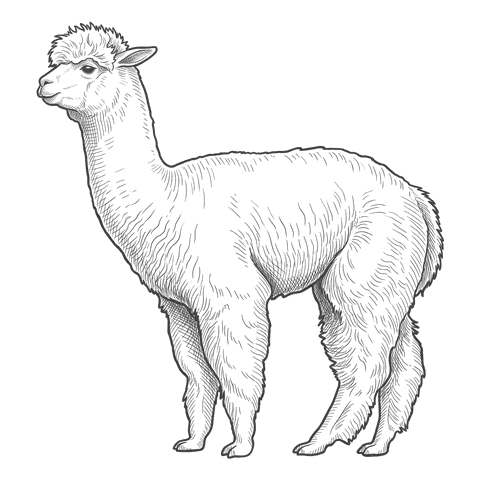
Andean peoples have raised the alpaca for thousands of years, and to the Incas its fibre was so precious it was called the fibre of the gods, reserved for the nobility. It lives on the high plateau above four thousand metres, where its fleece is its defence against extreme cold. Today Peru is by far the world's largest producer, and the great historic mills are clustered around Arequipa.
How the yarn is made
It is obtained by shearing, normally once a year. The fleece is then sorted by hand for fineness, on a scale that runs from the finest grades (Royal and Baby) to the coarsest. Unlike wool, alpaca contains almost no lanolin: it does not need heavy scouring and yields much more usable fibre per fleece.
Why it is prized
It is warmer than wool for the same weight, because the fibre is hollow inside and traps air. It is silky and does not prickle, and is often tolerated even by people sensitive to wool, precisely because it lacks lanolin. It also offers a very rare palette of natural colours, from white through fawn and grey to black, with no need for dyeing.
Dyeing
Excellent. As a protein fibre it binds acid dyes with good fastness and brilliance. Many yarns, however, are left undyed precisely to show off the richness of the coat's natural colours, from warm tones to pearly greys.
Care
Wash it by hand or on a delicate cycle, in cold water with a detergent for delicates, and always dry it flat. Its real weak point is weight: under its own load the garment stretches and grows, so it should never be hung on a hanger. It felts if agitated in warm water, though less than wool.
End of life
Biodegradable and compostable like all untreated protein fibres. It can be mechanically recycled, and extensive Andean herding, at low density and without intensive feed, makes it one of the lowest-impact animal fibres.
How to recognise it
| Hand | Silky, slippery and warm, with a fluid softness that wool lacks. It does not prickle and does not leave the greasy feel of lanolin. |
|---|---|
| Look | Slight lustre, marked in the Suri type, and very little crimp. It develops a bright, airy halo and often shows deep natural colours. |
| Behaviour | It drapes and falls under its own weight, recovers little after stretching and is very warm. The knitted fabric tends to lengthen over time. |
| Burn test | Protein signature: it burns slowly and self-extinguishes, smells of burning hair, and leaves a crumbly black bead, like all animal fibres. |
| Home tests | Burn test: slow flame, goes out on its own, crumbly ash (confirms the family only) · Touch test: smoother, warmer and less springy than wool · Weight test: a knitted swatch tends to give and lengthen under its own load |
| Confused with | Merino wool: but alpaca is smoother, warmer and clearly less elastic · Cashmere: both are very soft, but alpaca is more lustrous, heavier and gives more |
| Only in a lab | Telling alpaca apart with certainty from wool and other animal hairs requires laboratory microscopy (ISO 17751): in alpaca the inner medullary canal (medulla) is often visible. |
Physical facts
| Property | Value | Source |
|---|---|---|
| elastic memory | Low | research |
| sag | Very high (heavy) | research |
| halo | High | research |
| felting risk | High | research |
| fineness (µm) | 18–30 | measured |
| moisture regain (%) | 12.0 | research |
| typical shrinkage (%) | 0–8 | estimate |
| staple length (mm) | 70–150 | research |
measured = a measurement with a reference · iso = a standard · research = a verified source · estimate = plausibility only
For the fabric engine
| friction coefficient (µ) | 0.24 | measured |
|---|---|---|
| density (g/cm³) | 1.31 | measured |
| Young's modulus (GPa) | 3.0 | measured |
| specific bending stiffness (dyn·cm²/tex²) | 0.22 | estimate |
Good for
shawls and stoles with good drape · warm garments that fall softly · silky, voluminous accessories · capes and long cardigans
Less good for
cuffs and ribs that must hold · shoulders and load-bearing structures · fitted garments that must spring back · very stretchy knitwear (wool is better)