
Fibres · Plant
Abaca / Manila hemp
The hard fibre par excellence: stiff, tough and almost legendarily resistant to water. It is not a yarn for garments but the material that holds up a bag, a basket or an object that has to stand on its own.
Translated from Italian. A native knitter has not reviewed this translation yet.
History
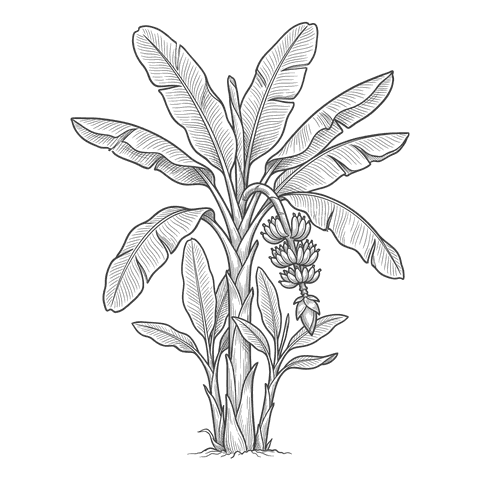
Obtained from a plant related to the banana, abaca owes to its homeland, the Philippines, the trade name it has carried for centuries: Manila hemp, after the port its bales sailed from. Before it became a craft fibre it was above all a fibre of the sea: for generations it made the ropes and mooring lines of fleets across half the world, because it did not rot in salt water. Today, besides the Philippines, it is grown in Ecuador and Central America.
How the yarn is made
It is neither shorn nor harvested as a staple: the pseudostem of the plant is cut and its leaf sheaths are peeled away, and the fibre ribbons are drawn from them. The strip is scraped by hand or by machine to free it from the pulp (stripping, or decortication), then washed and dried in the sun. What remains are long, lustrous ribbons, graded by colour and fineness and then spun or plaited depending on the use.
Why it is prized
It is one of the strongest and most durable natural fibres there is, and that makes it valuable exactly where soft knitwear cannot go: in accessories and furnishings that have to carry a weight and hold a shape. It keeps its structure without giving way, resists water and wear, and gives the finished object a dry lustre and a firm character.
Dyeing
Being cellulosic, it takes direct and reactive dyes like cotton and linen, but the smooth, waxy surface of the fibre holds colour less well: shades tend to stay softer and more natural. For this reason it is often left in its warm ivory or taken towards earthy tones, where its lustre shows best.
Care
It wants the care of a stiff fibre, not of knitwear. Clean it dry or with a damp cloth and let it air-dry, away from direct heat, which would stiffen it further. Do not wring it and do not put it in the washing machine: a structural object should be dusted and aired, not washed like a garment.
End of life
It is one hundred per cent plant fibre: biodegradable and compostable at end of life, provided it has not been coated or bonded to synthetic materials. Its strength also makes it easy to reuse, and the same fibre feeds industries such as speciality papers and tea bags.
How to recognise it
| Hand | Rough, dry and distinctly stiff, cool to the touch like all plant fibres. This is not a fibre that caresses: you feel the structure under your fingers. |
|---|---|
| Look | Dry lustre, almost silky on the best ribbons, with a warm ivory ground colour that turns brownish in the coarser grades. Straight fibre, with no crimp and no halo at all. |
| Behaviour | No elastic recovery: what you fold stays folded, and that is exactly what lets it hold a shape. Very resistant to tension and to water, it tends instead to snap if bent a thousand times at the same point. |
| Burn test | Cellulosic signature: it catches fire quickly with an open flame, smells of burning paper or wood, leaves an afterglow, and a light grey ash residue. |
| Home tests | Burn test: quick flame, smell of burning paper, crumbly grey ash · Stiffness test: a ribbon does not straighten again after being folded · Water test: when wet it holds under tension instead of giving way |
| Confused with | Sisal and other hard cordage fibres: almost identical handle and burn behaviour · Raffia and plaiting fibres: but abaca is more lustrous, longer and much stronger |
| Only in a lab | Telling abaca apart with certainty from the other hard cellulosic fibres (sisal, true hemp, jute) requires laboratory microscopy, because by eye and in the flame they behave almost the same. |
Physical facts
| Property | Value | Source |
|---|---|---|
| elastic memory | None | research |
| sag | None (structural) | research |
| halo | None | research |
| felting risk | None | research |
| fineness (µm) | — | research |
| moisture regain (%) | 14.0 | research |
| typical shrinkage (%) | 0–3 | estimate |
| staple length (mm) | 1000–3000 | research |
measured = a measurement with a reference · iso = a standard · research = a verified source · estimate = plausibility only
Good for
bags and baskets that hold their shape · hats and structured accessories · belts and handles · home furnishings · plaiting and rigid objects
Less good for
stretchy knitwear and ribs · next-to-skin garments · soft drape · anything that must spring back after stretching